
Signs Your AC Capacitor Is Failing: 8 Red Flags
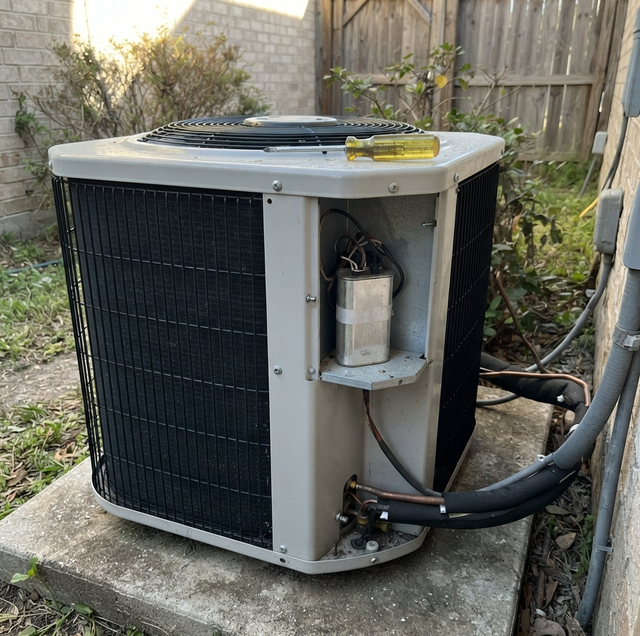
Quick Answer: A failing AC capacitor usually shows up first as an outdoor unit that hums but won't start, a fan blade that sits still or needs a nudge to spin, weak cooling, or a clicking sound as the system tries and fails to fire up. A swollen top or a burning smell means it has already gone. Testing and replacing a capacitor is licensed-pro work, because the part holds a live electrical charge even after the power is off. Shut the system down and call a technician rather than running it, since a struggling motor pulls hard on the compressor.
You set the thermostat, wait for that familiar whoosh of cold air, and instead the house stays warm. Walk out to the outdoor unit, and you might hear a low hum with nothing turning, or find the fan sitting dead still while everything else seems powered up. A worn capacitor is one of the most common reasons a running-fine air conditioner suddenly can't get itself going. It is a small part doing a big job, and when it weakens, the whole system stalls at the starting line.
What a Capacitor Actually Does
An air conditioner has motors that need a strong shove to get moving and a steady hand to keep running: the compressor outside, the outdoor condenser fan, and the indoor blower. Those motors don't draw smoothly from household power on their own. The capacitor stores up a charge and then releases it in a burst, giving the motor the jolt it needs to break from a standstill and, in many designs, a continued nudge that keeps it turning efficiently once it's up to speed.
There are two jobs hiding in that description. A start capacitor delivers the heavy kick that gets a motor spinning from zero. A run capacitor provides the smaller, ongoing assist that keeps the motor running smoothly and holds its current draw in check. Capacitors are rated in microfarads, written as µF or MFD, a measure of how much charge they can hold. That rating is printed right on the body of the part, and it matters a great deal, because a capacitor that can no longer hold its rated microfarads can't deliver the push its motor was built to expect.
A capacitor is a bit like the coiled starter cord on a small engine: the motor has the power to run all day, but without that one sharp pull to get it turning over, it just sits there. When the capacitor weakens, the pull gets softer, and eventually there isn't enough snap left to start the motor at all.
The Warning Signs of a Failing Capacitor
Capacitors tend to fade rather than fail all at once, so the symptoms often creep in over days or weeks before the final stall. Here is what that decline sounds and looks like.
The unit hums but won't start: This is the classic sign. Power is reaching the motor, so it buzzes or hums, but the capacitor can't supply the starting jolt, so the motor never actually turns. A compressor or fan stuck in that humming state is straining, and it should not be left running that way.
Hard starting or slow starts: Before it quits entirely, a weak capacitor often lets the system start, just reluctantly. You might notice a pause, a groan, or a hesitation each time the unit kicks on, where it used to fire up cleanly. That labored start is the motor fighting to move on a shrinking charge.
The outdoor fan won't spin: If the condenser fan blade sits motionless while the unit hums, the fan's capacitor is a prime suspect. A telltale detail: sometimes the blade will start turning if you give it a push, then run until the next cycle, only to stall again on the next start. That nudge-and-go behavior points squarely at a spent capacitor.
Weak or warm airflow: When the run function fades, motors turn slower and less efficiently than they should. The compressor can't build proper pressure, and cooling drops off even though the system appears to be running. Air comes out of the vents, but it isn't cold the way it used to be.
Clicking or repeated attempts to start: A rhythmic clicking from the outdoor unit is often the control relay trying to fire the system, failing, and trying again. That repeated on-off attempt frequently traces back to a capacitor that can no longer close the deal.
The system shuts off on its own: A motor working without proper capacitor support overheats, and its internal safety cutoff shuts it down to protect it. The unit may run for a while, quit, then restart once it cools. That come-and-go pattern is easy to blame on the thermostat, but a fading capacitor is a common culprit.
A swollen or bulging top: A healthy capacitor is flat-topped. A failing one often bulges, domes, or splits at the top as pressure builds inside, and it may leak an oily residue. This is a visible sign of a part at the end of its life. It sits inside the electrical compartment, though, so this is something your technician confirms, not something to go hunting for yourself.
A burning or acrid smell: A capacitor that has shorted or overheated can give off a sharp, burning odor near the outdoor unit. Treat that smell as a stop sign: shut the system down and leave it off until a professional has looked at it.
Why Capacitors Wear Out
Nothing about a capacitor's decline is a sign you did something wrong. These parts are consumable by design, and a handful of forces wear them down.
Heat is the big one, and it cuts two ways. The long summer stretch, when the outdoor unit runs for hours in direct sun and high ambient temperatures, cooks the capacitor and shortens its life. But heat isn't only a summer story: the electronics run warm every time the system cycles, all year long, and each hot-then-cool swing ages the internal materials a little more. Age alone gets most capacitors in the end, since the materials that store the charge break down gradually over years of use regardless of season. Voltage spikes, from utility surges or nearby lightning, can damage a capacitor in an instant or quietly shorten its remaining life. And a wrong microfarad rating, if a previous replacement used a part that didn't match the motor's specification, forces the system to run outside its design and burns through capacitors faster than it should.
Single vs Dual Run Capacitors
Not every system carries the same setup. Many air conditioners use a single run capacitor dedicated to one motor, plus separate capacitors for the others. A lot of residential units, though, use a dual run capacitor, a single can that serves both the compressor and the condenser fan from one part with multiple terminals. The terminals are usually marked for their jobs, commonly HERM for the compressor and FAN for the fan, with a shared common terminal.
Why this matters to you: with a dual capacitor, one failed section can take out the fan while the compressor still tries to run, or the reverse, which is why symptoms sometimes look partial or puzzling. Identifying which type your unit has, and which section has weakened, is part of what a technician sorts out during diagnosis.
How a Technician Tests a Capacitor
A guess isn't good enough here, because a capacitor can look fine and still be out of spec. A technician safely discharges the part first, then measures it with a multimeter set to read capacitance, comparing the actual reading in microfarads against the rating printed on the capacitor's body. A part that reads well below its rated µF, often the rule of thumb is more than about 10 percent low, is failing and due for replacement even if the system still limps along. The tech also inspects for bulging, leaking, or burnt terminals, and confirms the replacement part matches the original's microfarad and voltage rating exactly.
That discharge step is not a formality. A capacitor stores a live electrical charge even after the power to the unit is off, and that stored energy can deliver a serious shock. This is the core reason capacitor testing and replacement is licensed work and not a homeowner task. There is no safe way to poke around the electrical compartment to check one yourself.
An AC capacitor stores a live electrical charge even after the power to the unit is off, and that stored energy can deliver a serious shock. This is the core reason testing and replacing one is licensed work, not a homeowner task, so do not open the electrical or disconnect panel or touch the capacitor yourself. If you notice a burning or acrid smell near the outdoor unit, shut the system down and leave it off until a professional has looked at it.
What you can safely do: Homeowners do have a few safe moves before the tech arrives. You can turn the system off at the thermostat so a struggling motor isn't left straining. You can check and replace the thermostat battery, since a dead thermostat can mimic a no-start. And you can listen and observe from a safe distance, noting the hum, the clicking, or the still fan, so you can describe the behavior when you call. What you should not do is open the electrical or disconnect panel or touch the capacitor. Leave the compartment closed and hands-off.
What Happens If You Keep Running It
It is tempting to nudge the fan, let the unit limp through a hot afternoon, and put off the call. That gamble tends to cost more than it saves. When a capacitor can't support the compressor, the compressor draws far more current than normal as it strains to start and run. That excess current builds heat in the motor windings, and repeated hard starts wear on the compressor's internal components. The compressor is the single most expensive part of the system, and pushing it to run without proper capacitor support is one of the faster ways to turn an inexpensive fix into a major one. The moment the symptoms show up, the smart move is to shut the system off and have the capacitor checked.
Frequently Asked Questions
Most run capacitors last somewhere in the range of 10 to 20 years, but the working average under sustained high operating temperatures often lands closer to 5 to 15 years, because heat shortens their life. A capacitor installed when the system was new is well within the window to fail, which is why techs often check it as part of routine maintenance on any system past its first decade.
Yes. A capacitor that has shorted internally can cause the motor to draw a heavy overcurrent, and the breaker may trip to protect the circuit. If your outdoor unit keeps tripping its breaker, resist the urge to keep resetting it, since repeated resets on a shorted component can worsen the damage. That is a call-a-pro situation rather than a reset-and-hope one.
Not quite. A hard-start kit is a separate add-on, essentially a start capacitor paired with a relay, that gives a struggling compressor extra starting torque. It supplements the system's existing run capacitor rather than replacing it, and it is sometimes added to help an older compressor start. A technician decides whether a unit needs a straight capacitor replacement, a hard-start kit, or both.
It can. As a run capacitor weakens, the motors it supports draw more current and run less efficiently to do the same work, which shows up as higher energy use before the part fails outright. A noticeable jump in a cooling bill, paired with any of the starting symptoms above, is worth having looked at.
Often, yes. A capacitor near the end of its life can hold just enough charge to start the system in cooler morning temperatures, then fail to start once the afternoon heat pushes both the ambient temperature and the electrical load higher. That temperature-dependent, works-then-doesn't pattern is a classic marginal-capacitor signature.
It fixes the capacitor, but a capacitor that failed unusually early can be a symptom of something else, such as a motor that runs hot, an overheating compressor, or a chronic voltage problem on the line. A good technician looks for the reason a young capacitor died rather than simply swapping in a new one and walking away, so the replacement actually lasts its full expected life.
Hearing a hum with no cool air? Get it diagnosed before the compressor pays for it. Above & Beyond Air Conditioning & Heating serves San Antonio and the surrounding Hill Country. TACLA00095687E. Call (210) 897-8658.
