
How Often to Change Your HVAC Air Filter: 5 Signs
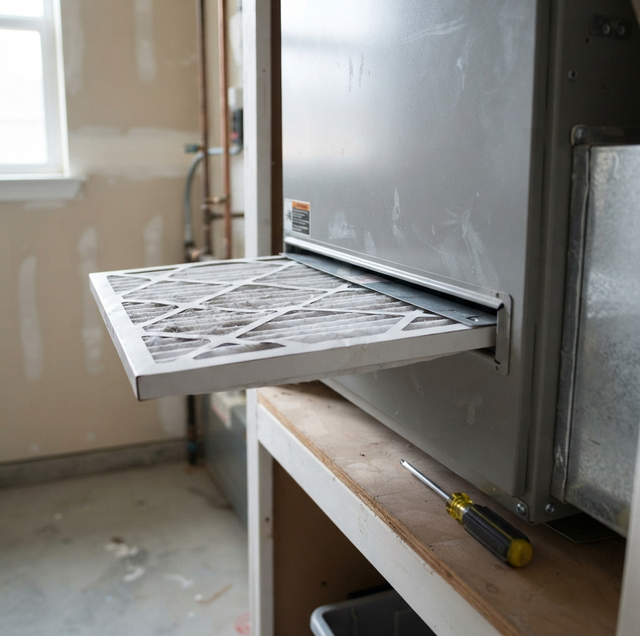
Quick Answer: For most homes, change a standard 1-inch HVAC filter every 30 to 90 days, and inspect it monthly. Pets, more people in the house, heavy run time, and higher-MERV filters all push you toward the shorter end. A thick 4-to-5-inch media filter often lasts 6 to 12 months.
Most people assume the air filter is there to clean the air they breathe. That part is real, but it is a side benefit. The filter's main job is to protect the equipment. It sits in the return airstream and traps dust, lint, pet hair, and grit before that debris can settle on the evaporator coil, coat the blower wheel, or work its way into the motor. A clean coil transfers heat the way it was designed to. A blower with clean blades moves the air volume the system was built around. When you keep the filter fresh, you are really keeping the expensive parts clean.
What the Filter Actually Does for Your System
A furnace or air handler is basically a big fan pulling household air across a coil and pushing it back out through the ducts. Everything downstream of the filter depends on that air staying clean. Skip the filter, or let it clog, and dust builds up where you cannot easily reach it.
The evaporator coil is the part that suffers most. When a fine layer of dust bonds to the coil fins, it acts like a blanket over the surface that is supposed to absorb heat. The system has to run longer to reach the same temperature, and cleaning a fouled coil is a technician job involving specialized coil cleaner and access panels, not a filter you swap in two minutes. The blower motor is the other casualty. A dust-caked blower wheel spins out of balance and moves less air, which drags on the motor and shortens its life.
So the filter is a cheap, replaceable shield standing in front of parts that are neither cheap nor quick to clean.
Why a Clogged Filter Chokes the Whole System
Air conditioning and heating both depend on a steady volume of air passing across the coil. The filter is the narrowest point that air has to squeeze through on its way in. A dirty filter is like trying to breathe through a folded blanket. The fan strains, less air makes it through, and problems cascade from there.
In cooling mode, low airflow lets the evaporator coil get too cold. Moisture on the coil can freeze into a sheet of ice, and once that happens, the system nearly stops cooling until it thaws. In heating mode, restricted airflow lets heat build up inside the furnace instead of moving out into the rooms, which can trip the high-limit safety and cause the system to short cycle, snapping on and off without finishing a real run.
Either way, the equipment works harder for less comfort, and that extra run time shows up on the energy bill.
The General Rule: Every 1 to 3 Months
The baseline for a standard 1-inch pleated filter is every 30 to 90 days. A good habit is to check it monthly, hold it up, and decide. Some months it will still look clean, and you leave it. Other months it is packed, and you swap it early. The calendar is a starting point, not a hard rule, because the real answer depends on how much junk your home puts into the air and how hard the system runs.
Here is what pushes you toward changing more often:
Pets in the House: Dander and shed hair load a filter fast. One shedding dog or cat can take a filter that would have lasted three months down to about one. Two or more animals, plan on monthly.
More People, More Activity: Every person tracks in dust and sheds skin cells and fibers. A busy household of five loads filters faster than a quiet home of two. Recent remodeling, sanding, or drywall work throws fine dust into the air that will clog a filter in weeks.
Heavy Run Time in Heat and Cold: Your filter only collects debris when air is moving through it. During a long stretch of hot weather, the AC may run most of the day, and during a cold snap the heat runs the same way. Both seasons pull far more air, and far more dust, through the filter than a mild spring or fall week does. The busy end of both seasons is exactly when a filter loads fastest, so do not stretch the interval just because the calendar page turned.
Cheaper 1-Inch Filters: The thin fiberglass panels sold as spun blue mats catch big debris but let fine dust pass, and they collapse or load quickly. A better pleated 1-inch filter traps more, but the more it traps, the sooner it fills. Cheaper filters simply need attention sooner.
Understanding MERV Ratings and the Airflow Tradeoff
MERV stands for Minimum Efficiency Reporting Value, a scale from roughly 1 to 16 for residential filters. The higher the number, the smaller the particles the filter catches. A MERV 8 grabs household dust and pollen. A MERV 11 or 13 also catches finer particles like smoke and some bacteria-sized matter.
The catch is that a denser filter is harder to pull air through. A high-MERV filter dropped into a system that was not designed for it can starve the blower of air, and that is when you see the same trouble a clogged filter causes: weak airflow, a frozen coil in summer, and a straining motor. More filtration is not automatically better. The filter has to match what the equipment can handle.
For most homes, MERV 8 to 11 is the practical sweet spot. If someone in the house has allergies and you want to go higher, the safe move is to have a technician confirm the system can move air through it without choking, or step up to a thicker media cabinet built for denser filters.
1-Inch Filters vs 4-to-5-Inch Media Filters
The slot your filter sits in tells you a lot. A standard 1-inch slot holds a thin filter with limited surface area, so it fills up on the 1-to-3-month cycle.
A 4-to-5-inch media filter is a different animal. It is a deep pleated cartridge in a dedicated cabinet, and because it packs far more pleated surface into the airstream, it can filter well while staying easier to pull air through. Those thick filters often run 6 to 12 months between changes and hold a lot more dust before they restrict airflow. If your system has a media cabinet, it is worth the modest cost of the cartridge. If it does not, you cannot simply cram a thick filter into a 1-inch slot; the cabinet has to be there.
How to Check and Change It Correctly
Checking a filter takes under a minute. Turn the system off at the thermostat first so the blower is not pulling air while the slot is open, then slide the filter out and hold it up to a light or a bright window. A filter you can see light through clearly is fine. One where the light is dim, gray, or blocked across the pleats is done, regardless of what the calendar says.
Do not treat the calendar as a hard rule. Check a standard 1-inch filter monthly by holding it up to a bright light; if you can see through the pleats clearly, it is still fine, and if the light looks dim, gray, or blocked, it is done. Writing the install date on the cardboard edge before you slide a new one in shows you at a glance how long it has been in.
Two details matter when you put the new one in:
Match the Size Exactly: The size is printed on the cardboard edge, something like 16x25x1. Use that exact size. A filter that is too small leaves gaps where unfiltered air, and all its dust, sneaks around the edges straight onto the coil.
Follow the Airflow Arrow: Every filter has an arrow printed on the frame showing airflow direction. It points the way the air travels, toward the blower and away from the return. Install it backward, and the filter works against its own design and loads unevenly. Note the arrow direction before you pull the old one out so the new one goes in the same way.
Symptoms of a Clogged Filter
The filter often warns you before it fails outright. Watch for these:
Weak Airflow From the Vents: If the air trickling from the registers feels weaker than usual, a choked filter is the first thing to rule out.
Higher Energy Bills: A restricted system runs longer to do the same work. A bill that climbs with no change in weather or habits can point back to a filter nobody has checked in months.
A Frozen Coil in Cooling Mode: Ice on the copper lines or the indoor coil, or an AC blowing warm air on a hot day, frequently traces to low airflow from a clogged filter. Shut the system off, let it thaw, and check the filter first.
Short Cycling: If the system snaps on and off in quick bursts without finishing a run, restricted airflow may be tripping a safety limit. A fresh filter is the cheapest thing to try before calling for service.
If a new filter, correctly sized and installed, does not clear these symptoms, the trouble is deeper in the coil, blower, or refrigerant side, and that is where a licensed technician comes in.
Frequently Asked Questions
No. Standard pleated and fiberglass filters are not built to be washed; soaking them ruins the pleats and the media, and a damp filter left in the system can grow mold. Only filters specifically labeled washable or electrostatic are meant to be rinsed, and those have to dry completely before they go back in. If yours does not say washable on the frame, replace it rather than clean it.
Not always. Past a certain density, a filter can restrict airflow more than your blower is rated to handle, which strains the motor and can freeze the coil. The best filter is the one that matches your equipment's airflow capacity, not the highest MERV on the shelf. A mid-range filter that lets the system breathe protects the equipment better than a premium one that chokes it.
Air still moves, but every bit of dust goes straight onto the coil and into the blower. Even a few weeks without a filter can start fouling the coil, and the debris that settles inside is far harder to remove than a filter is to replace. Running filterless also lets dust drift back into the ducts. If you are ever caught without a spare, it is better to buy one that day than to run the system bare.
In many homes, the filter sits behind a return-air grille on a wall or ceiling rather than at the equipment. Look for the large vent that pulls air in, usually the biggest grille in the house; it often has a hinged frame or clips holding a filter behind it. Some systems have both a grille filter and one at the air handler, so it is worth confirming you are not missing a second one.
The filter itself does not, but if you switch to a noticeably denser filter than before, watch the first week for weaker airflow or longer run times. Those are signs the new filter is too restrictive for the system. If you see them, drop back to a lower-MERV filter or have a technician check the static pressure across the filter to confirm the equipment can handle it.
Write the install date on the cardboard edge of the filter in marker before you slide it in, so the next check shows you exactly how long it has been in. Buying filters a few at a time and keeping the spares near the return also removes the excuse of not having one on hand. A recurring monthly phone reminder covers the rest.
Book a filter and airflow check today — keep your system breathing and running efficiently. Above & Beyond Air Conditioning & Heating serves San Antonio and the surrounding Hill Country. TACLA00095687E. Call (210) 897-8658.
