
Cracked Heat Exchanger: The Hidden Furnace Danger
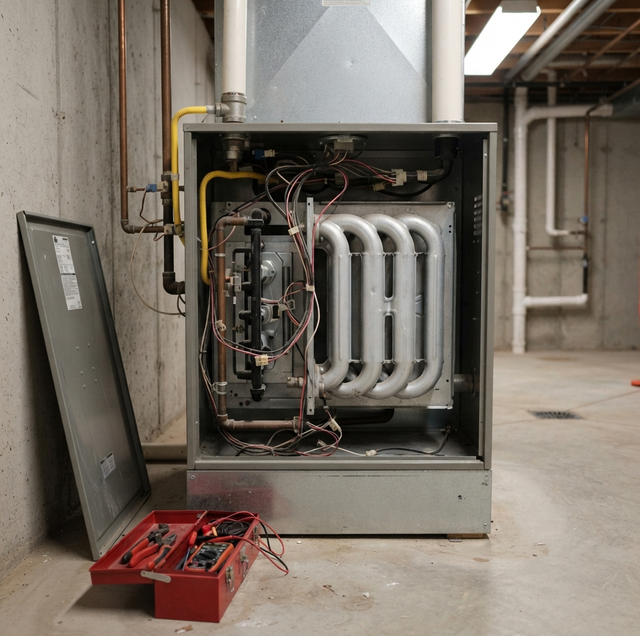
Quick Answer: A furnace heat exchanger is the sealed metal chamber that transfers heat from burning gas into your home's air while keeping the toxic exhaust, including carbon monoxide, separated from what you breathe. A crack breaks that seal and can let carbon monoxide leak into your airstream. A cracked exchanger almost always means the furnace needs replacement, and it should not keep running until a licensed tech inspects it.
Your gas furnace does two jobs at once, and it has to keep them completely apart. It burns fuel to make heat, and it warms the air that circulates through your home. The single part that lets it do both without mixing the two is the heat exchanger. When that part fails, the failure is not a comfort problem. It becomes a safety problem, because the barrier that keeps combustion gases out of your breathing air is exactly what a crack breaks.
Understanding what this metal chamber does, and why a crack in it matters so much, helps you know when to stop running a furnace and call a licensed technician instead of waiting for the next scheduled visit.
What a Heat Exchanger Actually Does
Picture the inside of a gas furnace as two separate air paths that run side by side but never touch. One path carries the products of combustion. The other carries the air that goes to your rooms. The heat exchanger is the wall between them.
When the furnace fires, gas burns at the burners and sends hot combustion gases up into the heat exchanger, which is usually a set of curved metal tubes or clamshell-shaped chambers. The metal gets hot. The blower then pushes cool household air across the outside surface of that hot metal. Heat passes through the metal wall into your air; the warmed air travels out through the ducts, and the leftover exhaust gases stay trapped inside the exchanger and vent safely out through the flue.
That separation is the whole point. Combustion produces carbon monoxide, a colorless and odorless gas that is poisonous to breathe. A working heat exchanger keeps every bit of that exhaust on its own side of the metal and sends it outdoors. Your home's air only ever picks up heat, never the fumes.
The Order of Operations: The sequence matters because each step depends on the last. Burners ignite, the metal heats, a safety sensor confirms the exchanger is warm, and only then does the blower start moving house air across it. Exhaust exits through the flue the entire time. When the thermostat is satisfied, the burners shut off, the blower runs a little longer to pull the remaining heat off the metal, and the cycle ends.
Why a Crack Is Dangerous
A heat exchanger works by keeping two things apart with a thin metal wall. A crack, split, or corroded hole in that wall removes the separation. Even a hairline crack can open under heat, because metal expands when it warms and contracts when it cools, so a gap that looks closed when cold can flex open during a firing cycle.
Once there is an opening, combustion gas on the inside can mix with the household air moving across the outside. That means carbon monoxide can enter your airstream and get distributed to every room the ducts serve. Because carbon monoxide has no color and no smell, a leak gives no obvious signal on its own. People can be exposed for a long time before anyone suspects the furnace, which is what makes this failure more serious than a part that simply stops working.
Carbon monoxide interferes with the blood's ability to carry oxygen. At low levels, it causes headaches, dizziness, and nausea. At higher levels it can be fatal. A cracked heat exchanger is dangerous specifically because it can put that gas where people breathe, quietly.
What Causes Heat Exchangers to Crack
Cracks are rarely a single dramatic event. They usually build up over time from ordinary stress the metal takes every heating cycle.
Metal Fatigue From Heating and Cooling: Every time the furnace runs, the exchanger metal heats up and expands, then cools and contracts when the cycle ends. Repeat that thousands of times over many years and the metal fatigues, the same way a paperclip snaps after you bend it back and forth enough times. Fatigue cracks tend to start at bends, seams, and weld points where the metal takes the most stress.
Overheating From Restricted Airflow: If the blower cannot move enough air across the exchanger, the metal runs hotter than it was designed to. A clogged air filter is the most common cause, because it starves the blower of return air. Blocked or undersized ductwork, closed supply registers, and a dirty blower wheel do the same thing. Sustained overheating accelerates fatigue and warps the metal, which invites cracks sooner than normal aging would.
Oversizing and Short Cycling: A furnace that is too large for the home heats up fast, satisfies the thermostat quickly, and shuts off, then repeats that pattern over and over. Those frequent, sharp temperature swings stress the exchanger more than longer, steadier runs would. Oversizing is a design mistake made at installation, and it shortens the exchanger's life.
Age and Corrosion: Heat exchangers do not last forever. As a furnace approaches and passes the far end of its service life, the metal thins and the odds of a crack climb. Corrosion speeds this up. Condensation, combustion byproducts, and moisture from a nearby leak can rust the metal from either side, and rust weakens the wall where a crack can form.
Warning Signs Worth Taking Seriously
No single sign confirms a cracked exchanger by itself, but several point toward combustion trouble that a technician should inspect right away.
A Carbon Monoxide Alarm: This is the clearest warning and the one to never ignore. A CO alarm going off means measurable carbon monoxide is in your living space. Treat it as an emergency, not a false alarm.
A Yellow or Flickering Burner Flame: A healthy gas flame burns steady and blue. A flame that turns yellow, orange, or flickers can signal incomplete combustion or air being disturbed by a crack in the exchanger. A flame that visibly moves or pulses when the blower kicks on is a particular red flag, because it can mean air is leaking through an opening.
Soot, Odd Odors, and Physical Symptoms: Soot or dark streaks near the furnace point to incomplete combustion. A strange, sharp, or aldehyde-like odor near the unit can accompany a combustion problem, though carbon monoxide itself has no smell. The most telling sign is how people feel: headaches, dizziness, nausea, or flu-like symptoms that appear when the heat is running and ease when you leave the house strongly suggest CO exposure.
If a CO alarm sounds, or anyone feels those symptoms, get everyone outside into fresh air and call 911 or your gas utility from outside. Do not go back in to investigate.
Why a Crack Usually Means Replacement
When an inspection confirms a cracked heat exchanger, the common recommendation is to replace the furnace rather than the part alone. There are practical reasons for that.
The exchanger is buried at the core of the furnace, so reaching it means most of the unit comes apart. On an older furnace, the exchanger is often the first major component to fail, which signals the rest is aging too. A crack cannot be safely patched, sealed, or welded in place. Any repair that leaves the original compromised metal in service is not a safe fix, because the seal between exhaust and breathing air has to be intact, not merely closed for now.
For those reasons, and because the furnace's job is to heat air without poisoning it, a confirmed crack in a furnace that has served most of its life usually points toward a full replacement rather than a repair.
A cracked heat exchanger can let carbon monoxide, a colorless and odorless gas, leak into the air your ducts send to every room, and it can do so with no smell or visible sign until people feel sick. If a CO alarm sounds, or anyone has headaches, dizziness, or nausea when the heat is running, get everyone outside to fresh air and call 911 or your gas utility from outside. Do not keep running the furnace, and do not try to seal or patch the crack, until a licensed technician has inspected it.
Protecting Your Home: Detectors and Inspection
Two habits do the most to keep this hazard from becoming a tragedy, and both apply year-round, not only when the heat is running hardest.
Install carbon monoxide detectors on every level of the home and near sleeping areas, and test them on a regular schedule. Replace the batteries as recommended and replace the whole alarm when it reaches the end of its rated life, which is often around seven to ten years depending on the model. A CO alarm is the one device that can detect the exact gas a cracked exchanger releases, so it is the backstop that protects you even before any visible sign appears.
Schedule an annual furnace inspection with a licensed technician. During that visit, the tech examines the heat exchanger, checks the burner flame, verifies proper venting, and measures combustion. Fresh filters and clear airflow between visits reduce the overheating stress that leads to cracks in the first place. Heat-exchanger inspection and any gas work are licensed HVAC work by design, because it takes the right tools and training to evaluate combustion safely.
Frequently Asked Questions
Usually not. Many cracks are hairline, hidden inside the tubes or on surfaces you cannot see without partial disassembly, and some only open when the metal is hot. Technicians confirm cracks using tools you would not have at home, such as a combustion analyzer that measures carbon monoxide in the airstream, a video borescope camera fed into the tubes, and sometimes a pressure or spark test. Relying on a naked-eye look is why cracks go unnoticed for so long.
No. A blocked or disconnected flue, a backdrafting water heater, a gas range used to heat a room, a running vehicle in an attached garage, and portable generators or grills used indoors can all produce dangerous carbon monoxide. That is why a whole-home CO detector matters even if your furnace checks out fine, since it catches CO from any source, not just the furnace.
Not always, and that is part of the risk. A crack can leak intermittently, releasing gas only during certain points in the firing cycle or only once the metal expands to a certain temperature. It may pass a quick visual look yet still leak under real operating conditions. This is why technicians test with the furnace running and warm rather than only cold, and why a suspected crack is treated seriously even without a constant reading.
Not reliably. Standard furnace safety controls watch for things like overheating, flame failure, and blocked venting, but there is no dedicated sensor that detects a crack in the exchanger wall. A crack can exist while the furnace keeps running normally. Some newer high-efficiency models have sealed exchangers and pressure switches that add protection, but you should never assume the equipment will catch this on its own. A working CO alarm is the safeguard that actually watches for the leak.
Life spans vary by material and use, but many heat exchangers last roughly the full service life of the furnace, often in the range of fifteen to twenty years for a well-maintained unit. Hard use, oversizing, chronic dirty filters, and corrosion shorten that. A stainless-steel exchanger generally resists cracking and corrosion better than older aluminized-steel designs, though no exchanger is immune to fatigue over enough cycles.
No. If you have a reason to suspect a cracked heat exchanger, such as a CO alarm, a flickering yellow flame, or symptoms when the heat runs, stop running the furnace and have a licensed technician inspect it before using it again. Do not attempt to seal or patch the crack yourself, and do not let anyone talk you into a temporary sealant fix. The barrier between exhaust and breathing air has to be intact, and there is no safe do-it-yourself repair for a compromised exchanger.
Book a furnace safety and heat-exchanger inspection — protect your family's air year-round. Above & Beyond HVAC serves San Antonio and the Hill Country. TACLA00095687E. Call (210) 897-8658.
