
Why Your House Feels Cool but Clammy With the AC On
The thermostat reads a comfortable number, the vents blow cold, and yet the air still feels heavy and sticky against your skin. Wood floors feel tacky, mirrors fog, and the house has that damp basement quality even in a bedroom on the second floor. If that sounds familiar, your air conditioner is doing half of its job and skipping the other half.
An AC has two tasks that people usually lump together. It lowers the temperature, and it pulls moisture out of the air. Comfort depends on both. When the second task fails, you get exactly this: cool but clammy. Understanding why that happens is the difference between chasing the wrong repair and fixing the actual problem.
How an Air Conditioner Removes Moisture in the First Place
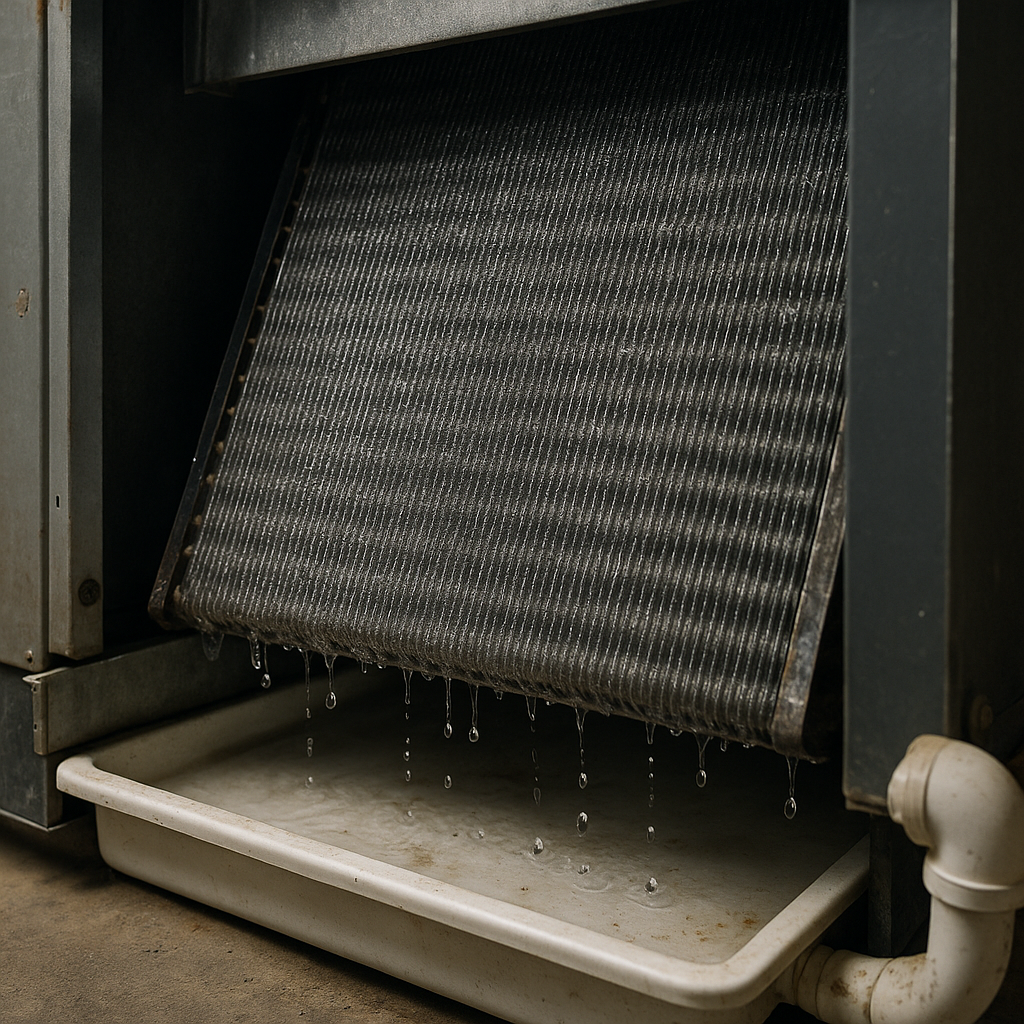
Your AC does not have a dedicated moisture-removal setting. It wrings water out of the air as a side effect of cooling. Warm, humid indoor air is drawn across the evaporator coil, the cold indoor coil located inside your air handler or furnace cabinet. That coil runs well below the dew point of the passing air, so water vapor condenses on the fins the same way beads of water form on a glass of iced tea on a summer afternoon. Those droplets collect, run down into the drain pan, and exit through the condensate line.
So the moisture your AC removes never becomes vapor again. It leaves the house as liquid water down a drain. This only works when two conditions are met: the coil must be cold, and air has to keep moving across it long enough for a meaningful amount of water to condense and drip away. Break either condition, and the temperature can still fall while the humidity barely moves.
That is the whole mechanism, and nearly every humidity complaint traces back to a failure somewhere in it.
Sensible Cooling Versus Latent Cooling, in Plain Terms
HVAC techs split the work into two buckets. Sensible cooling lowers the air temperature, the change your thermostat measures. Latent cooling removes moisture, which the thermostat does not measure at all. A system can post a strong sensible number and a weak latent number on the same afternoon. That is precisely the cool-but-clammy house: plenty of temperature drop, not enough moisture removal.
The reason this split matters is that a standard thermostat only watches temperature. Once the room hits its setpoint, the system stops, whether or not it has run long enough to dry the air. On a mild day in particular, the temperature target is met quickly, and the moisture just sits there.
Why Your House Stays Humid With the AC Running
Here are the failures that keep the air damp, roughly in the order a technician typically finds them.
An oversized system that short-cycles- This is one of the biggest and most overlooked causes. An air conditioner sized too large for the house blasts the rooms to the setpoint in a few short minutes, then shuts off. Moisture removal is slow work that requires sustained runtime, and a unit that runs only in short bursts never stays on long enough to condense much water. The result is a home that feels cold and damp at the same time, and it is harder to fix than an undersized one because the equipment itself is wrong for the load.
The fan is set to ON instead of AUTO- On AUTO, the blower runs only while the system is actively cooling. On ON, the blower runs continuously, including after the compressor cycles off. That matters because there is still liquid water clinging to the coil right after cooling stops. With air blowing across that wet coil, some of the water evaporates back into the airstream and gets pushed right back into your rooms before it can drain away. AUTO lets that water drip down and leave.
A dirty coil or a clogged condensate drain- A coil caked in dust and biofilm cannot transfer heat well, so it does not get as cold and condenses less water. And if the condensate line clogs, which is common with mineral-heavy water, the water that does condense has nowhere to go. It backs up, and eventually, a float switch shuts the whole system down.
Low refrigerant- If the charge is low, the coil temperature and pressure drift out of their design range, and dehumidification suffers along with cooling capacity. Refrigerant does not get used up; a low charge means a leak, and that is a sealed-system diagnosis for a certified technician.
Leaky ducts pulling in unconditioned air: Return ducts or an air handler that leaks into a hot attic or crawlspace draws in humid, outdoor-grade air and mixes it into the supply. Now the system is fighting a moisture load it was never meant to carry, and it loses.
Too little runtime on mild days, and a high fresh-air load- On a pleasant day, the system cools the house quickly and barely runs, so it barely dehumidifies. Add a leaky house that lets outdoor humidity seep in constantly, and the small amount of dehumidification the AC manages cannot keep pace.
Is This a Comfort Problem or a Cooling Failure?
Worth drawing this line clearly, because it changes what you do next. If the house reaches the temperature you set but still feels muggy, that is a dehumidification and comfort problem, and the fixes below apply. If the house never reaches the setpoint, if the system runs and runs and the rooms stay hot, that is a cooling-capacity failure, which points toward low refrigerant, a failing compressor, or airflow trouble, and it needs a diagnostic visit rather than a fan-setting change.
What Actually Fixes High Indoor Humidity
Set the fan to AUTO. Free, immediate, and it stops the re-evaporation problem. This is the first thing to try.
Have the coil and condensate drain serviced. A clean coil condenses more water, and a clear drain line carries it away instead of backing up. This is routine maintenance a tech handles on a tune-up.
Seal the ducts. Closing up leaks in returns and supply runs prevents the system from importing attic humidity and improves efficiency at the same time.
Right-size the equipment. If an oversized unit is short-cycling, no setting fully fixes it. Correct sizing based on an actual load calculation lets the system run longer, with gentler cycles that pull real moisture out.
Consider a whole-home dehumidifier. In a humid climate, there are stretches where even a healthy, correctly sized AC cannot keep humidity down on its own, particularly during long mild-but-muggy spells. A dedicated dehumidifier removes moisture independently of cooling, so you are not forced to overcool the house just to feel dry.
A Note on Humidity and the Season
In a hot, humid climate, humidity is a year-round conversation with two faces. During the long, hot cooling season, the AC runs almost constantly, which usually gives it plenty of runtime to dehumidify, so the failures that show up then tend to be dirty coils, clogged drains, or an oversized unit short-cycling. In the milder, muggier stretches of spring and fall, the opposite problem dominates: the AC barely runs because the temperature is already comfortable, so almost no moisture gets removed even though the outdoor air is damp. A good setup accounts for both, rather than being tuned only for peak summer.
What You Should and Should Not Touch Yourself
The homeowner side of this is short and safe: switch the fan to AUTO and keep the filter clean in the system so airflow across the coil stays healthy. Both help dehumidification and neither carries any risk.
Everything past that belongs to a licensed pro. Refrigerant work and any sealed-system diagnosis are legally restricted to EPA-certified technicians, and opening a coil, clearing a stubborn drain, or sealing ductwork in a hot attic involves real hazards and requires specialized tools. If the fan setting and a fresh filter do not solve the clamminess, that is the signal to bring someone out.
Frequently Asked Questions
It can. Set the fan to AUTO so the blower stops when cooling stops, letting the water on the coil drip into the pan instead of getting blown back into the rooms. If you want some air movement, use a short 'circulate' mode that runs the fan a few minutes an hour rather than continuously. Worth checking too: some smart thermostats add a dehumidify or overcool setting that lets the system pull extra moisture on humid days, which is more useful than leaving the fan on ON.
Yes. A unit too big for the house cools the air in short bursts and shuts off before it can run long enough to remove much moisture. You end up with a home that feels cold and damp at the same time. This is why matching equipment size to the home's actual load matters more for comfort than simply buying the largest system available.
The number to watch is indoor relative humidity, ideally somewhere around 45 to 55 percent. Above roughly 60 percent, the air starts to feel clammy, and mold gets a foothold on surfaces, even when the temperature reads fine. A cheap hygrometer on a shelf tells you whether the moisture side of the job is actually being handled or whether the system is only lowering the temperature and leaving the dampness behind.
Yes, and there is a way to measure it. A duct-leakage or blower-door test puts a number on how much unconditioned air the system is pulling in, so you are not guessing. Sealing the return leaks in a hot attic is often the specific fix, since a leaky return sits in the hottest, dampest space in the house and draws in the most humid air of anywhere in the duct run. Tightening those returns removes the moisture load at its worst point.
Sometimes the better first step is the AC itself. A variable-speed or two-stage system dehumidifies far better than a single-stage one because it runs longer at low output and keeps air moving across the cold coil rather than blasting and shutting off. A dedicated whole-home dehumidifier is the add-on for when even that cannot keep up, removing moisture on its own during long damp stretches so you are not forced to overcool the house to feel dry.
On a mild day, the AC satisfies the temperature target quickly and runs very little, so it barely dehumidifies during that short run. On a hot day, it runs long and often, which keeps air moving across the cold coil and pulls out far more water. That is why spring and fall can feel clammier indoors than the peak of summer.
Book a humidity and comfort check — get to the bottom of the clamminess before it turns into mold or a bigger repair. Above & Beyond Air Conditioning & Heating serves San Antonio and the surrounding Hill Country. TACLA00095687E. Call (210) 897-8658 for a free diagnostic visit.
