
What Does It Mean When Your Heat Pump Switches to Emergency Heat?
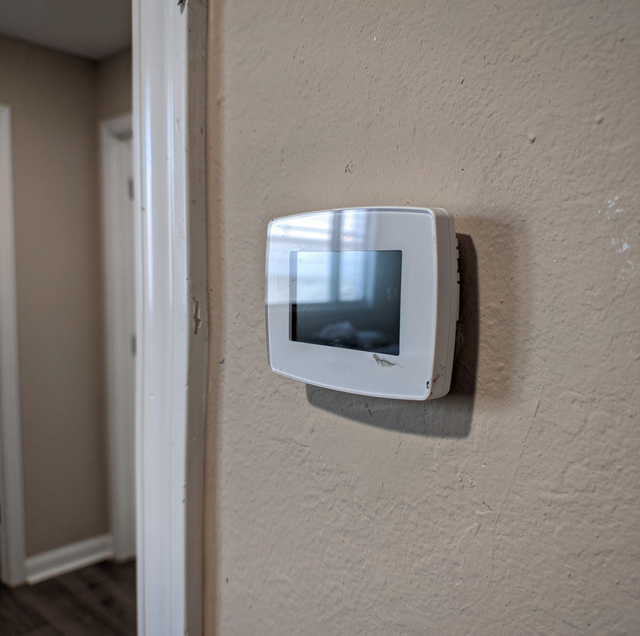
You walk past the thermostat at six in the morning, and it reads AUX, the way it has on every cold morning this week, and you think nothing of it. By midmorning it reads something else: EM HEAT. The air at the vents still feels warm. Nothing about the outdoor unit looks different from the sidewalk. Those two labels describe two very different things happening inside your equipment.
Auxiliary heat is automatic. The control board switches the backup heating element on to help a heat pump that is still running, so the compressor keeps moving heat and the electric strips add capacity on top of it whenever your house asks for more than the compressor alone can supply. Emergency heat is a thermostat mode. On a residential heat pump, it is a position on the mode selector that somebody chose, and while it is selected, the compressor is locked out of the circuit, and the backup element carries the entire heating load.
So the display has already told you half of what you need. Somebody set the thermostat to that mode: you, another person in the house, or a technician during a past visit. What is worth chasing is the condition that made the setting look necessary, because your heat pump does nothing for as long as the mode stays selected.
| Auxiliary Heat (AUX) | Emergency Heat (EM HEAT) | |
|---|---|---|
| Compressor | Still running, carrying its share | Locked out of the circuit |
| How it starts | Automatically, alongside the compressor | Chosen at the thermostat's mode selector |
| Typical duration | Minutes at a time, then clears | Continuous until someone switches it back |
| Relative operating cost | A modest add-on to compressor heat | Runs on the backup element alone |
How Auxiliary Heat Assists a Working Compressor
Your heat pump calls for auxiliary heat for three reasons, and each one still has the compressor doing its share of the work. One is recovering from a large temperature setback: if your thermostat dropped several degrees overnight and is then asked to climb back quickly, the compressor's steady, moderate output would take a long stretch to close that gap, so the backup element adds capacity temporarily to speed the recovery up. Once your house reaches setpoint, aux drops out, and the compressor carries the load on its own again.
A second trigger is the defrost cycle. In cold, humid weather, frost builds on the outdoor coil, so the system periodically reverses for a few minutes, sending warm refrigerant outside to melt it off. During that reversal, your indoor coil is not producing heat, so a system wired for it brings the backup element on for those few minutes to keep the air at your vents from feeling cool. It is a short, automatic, self-correcting event, and your thermostat still reads normal heat the entire time.
The third reason runs longest of the three: outdoor temperature itself. Every heat pump has a balance point, the outdoor temperature below which the compressor alone can no longer pull enough heat from outside air to match how fast your house is losing it. Below that point, aux is the second half of the system's heating capacity, covering the stretch of the season the compressor cannot handle solo.
Ask the technician what your system's balance point is. On a day well above it, aux running for long stretches, outside a defrost cycle or a morning setback recovery, is worth a service call rather than blaming the weather.
Why the Backup Element Costs More to Run
In a heat-pump-only system, the backup element is a set of electric resistance heating strips in the air handler: coils of wire that convert electrical current directly into heat with close to one-for-one efficiency. For every unit of electricity that goes in, roughly one unit of heat comes out. Your compressor works on a different principle. Rather than generating heat, it moves heat that already exists in the outdoor air, and moving existing heat costs far less energy than creating an equivalent amount from nothing, so a heat pump delivers several units of heat indoors for every unit of electricity it consumes.
That difference in mechanism is why the distinction between aux and emergency heat matters beyond the thermostat display. A few minutes of aux during a setback recovery or a defrost cycle barely register against that arithmetic. A thermostat left in emergency heat runs your house entirely on the less efficient side of that comparison for as long as the mode holds, with none of the compressor's heat-moving advantage offsetting it.
Why a Compressor Gets Locked Out of the Heating Cycle
You reach for emergency heat when the heat pump has stopped delivering heat, so the useful question about a thermostat sitting in that mode is what the compressor was doing at the time. A control board can also take the compressor offline on its own and run the backup element continuously, which feels much the same at the vents while your thermostat still shows normal heat with the aux light lit. Both situations trace back to the same short list of compressor problems, and there are five worth knowing.
A low refrigerant charge is one. Refrigerant that has leaked out reduces the amount of heat your system can absorb from the outdoor air, and a control board reading pressures outside the normal range can lock the compressor out as a protective step rather than letting it run under conditions it cannot handle. Finding that leak is a separate diagnosis with its own tools, well beyond what a thermostat display can settle.
A failed reversing valve is the second. That valve lets the same refrigeration cycle run in reverse for heating, and if it's stuck in the cooling position, the compressor can't produce heat indoors even if it's still running. Third, a defrost control board that sticks, either holding your system in defrost longer than it should or failing to end a defrost cycle at all, ties up the compressor's heating capacity the same way. Fourth, ice on the outdoor coil that goes well past a thin frost layer, thick enough to block airflow through the coil, chokes off the compressor's ability to pull in outdoor heat. And fifth, a thermostat wired incorrectly or configured for the wrong equipment type can energize the backup element directly, or set the aux threshold so low that your strips run when the hardware itself is fine.
Never chip, pick, or pry ice off your outdoor coil. The aluminum fins bend and tear under light hand pressure, and bent fins choke airflow across the coil. Ice that survives a defrost cycle needs a technician's look.
What Separates a Normal Pattern from a Fault
The fastest way to tell a normal aux cycle from a fault is how long it lasts and what set it off, since the indicator light alone does not carry that information. Aux that comes on during a hard overnight cold snap and clears once temperatures climb back up, or that appears for the few minutes a defrost cycle takes, or that shows up right after a big setback recovery and drops out once your house catches up, all fit a normal operating pattern. Aux that stays on for hours at a stretch on a day that is not especially cold, or that never clears no matter how long the compressor has been running, points to a mechanical limitation instead of a routine assist.
Emergency heat gives you no such signal, because it is a switch position: it holds continuously, regardless of outdoor temperature, until someone moves it back. So the pattern worth calling about shows up after you move the switch back. A thermostat nobody in your household remembers setting is worth tracing; so is a system that heats weakly and unevenly the moment you return it to normal heat, which points at the compressor itself.
What to Do When You Find Your Thermostat in Emergency Heat
If your thermostat is stuck in emergency heat and nobody remembers choosing it, the first step requires no tools: move the mode back to normal heat or to Auto, depending on the thermostat, and watch what happens over the next heating cycle. If the compressor starts, runs quietly, and your house heats normally, the setting was a leftover from an earlier service visit or a bumped switch, and nothing further needs doing. If the compressor does not seem to run at all, if your house loses ground, or if the heat feels weak and uneven as it did before, that is the time to call for service rather than keep flipping the switch and hoping the next attempt sticks.
One thing worth resisting while you wait for that appointment: setting the thermostat to emergency heat to stay comfortable. The mode keeps your house warm while keeping the compressor locked out, so your strips carry every hour in between, and the technician arrives with less to observe.
What a Technician Checks, and in What Order
A technician working through a heat pump that will not heat without the strips starts with the cheapest possibility to rule out: your thermostat's wiring and mode configuration, and whether the call-for-heat signal reaching the equipment matches what the display shows. From there, control boards that store a fault or lockout code reveal what tripped the compressor offline, narrowing the search before any panel comes off. Refrigerant charge and system pressures come next, since a shortage there explains a compressor locked out for its own protection. The reversing valve is checked to see whether it shifts refrigerant flow when it is told to, and the defrost control board and the outdoor coil round out the list. Working in that order rules out the least invasive explanations before anything more involved.
Frequently Asked Questions
That is a defrost cycle, timed off accumulated compressor run time regardless of how mild the day is. Time-and-temperature defrost controls initiate a cycle after 30 to 90 minutes of accumulated run time, when coil conditions call for one, and each cycle lasts about 5 to 15 minutes before the system returns to normal heating. Your backup element covers that short window, then shuts off the moment defrost ends.
It depends on your equipment. On a heat-pump-only system, the backup element is electric resistance strips, so emergency heat runs on electricity alone. On a dual-fuel system, where a heat pump is paired with a gas furnace instead of electric strips, selecting emergency heat shuts the heat pump out and runs the furnace by itself as the backup source.
The backup element carries its own high-limit safety switch, which cuts it off automatically if airflow is restricted or the air temperature climbs past a set threshold, so an extended stretch will not damage the strips themselves. What it does mean is that whatever pushed your system onto backup stays unresolved for every one of those hours.
Nothing. The mode de-energizes the compressor and the outdoor fan motor together, so the unit remains silent for the entire stretch and no defrost cycle runs, since defrost is a function of the refrigeration cycle. Snow or ice that collects on the outdoor coil during those days is still sitting there when you switch back to normal heat.
Compressor heat reaches your supply registers in the 90s Fahrenheit, warm to the hand without being hot, because the refrigerant's condensing temperature caps how hot the indoor coil gets. Resistance strips have no such ceiling, so they can push air well over 100 degrees. That jump in supply temperature is one clue your system has shifted onto backup before you check the display.
The two lights report different things. EM HEAT is wired to your thermostat's mode selector, so it reports the switch position and stays lit for as long as that mode is selected, whether or not the backup element is heating at that moment. AUX is wired to the call-for-heat signal from the control board, so it lights only during the minutes the backup element is actually energized.
A heat pump that only heats on backup is worth a diagnostic visit — a technician can pull the fault history, confirm whether your compressor is locked out, and get the system back on normal heat. Above & Beyond Air Conditioning & Heating serves San Antonio and the surrounding Hill Country. TACLA00095687E. Call (210) 897-8658.
