
What an Economizer on a Rooftop Unit Does — and When to Check It
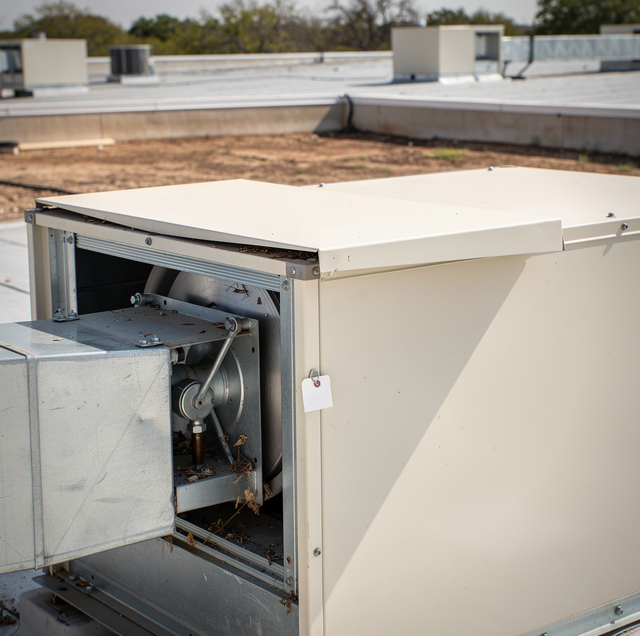
Ask your service contractor what the damper section on your rooftop unit did last spring. The ticket in your file may say nothing about it, and your building stayed comfortable through the season anyway.
That section is the economizer. Inside the cabinet, two linked dampers ride on a single shaft, driven by a motor, under a small controller that monitors the outside air. When the air is cool enough, the controller swings the blades open and lets it do the cooling your compressor would otherwise have to provide.
When the blades stop moving, nothing on your thermostat changes. The compressor takes that work back, your spaces hold setpoint, and the section sits shut for as many seasons as it takes somebody to open the panel.
The Damper Section Inside a Rooftop Cabinet
Two dampers do the work, moving against each other. One set of blades opens outward through a weather hood on the side of the cabinet; the other throttles the return air coming back from your spaces. A single actuator drives both through a common linkage, so the outdoor blades open by roughly the amount the return blades close and the volume of air crossing your cooling coil stays near what the fan was set to deliver. Downstream of where the two streams meet, a sensor sits in the mixed air and feeds the controller the reading it uses to position the blades.
The actuator is not a two-position device. It takes a modulating signal and parks the blades anywhere across their stroke, so your section can sit a tenth open at eight in the morning and wide open again an hour later, traveling between those positions while the supply fan keeps running. The controller drives that stroke toward a mixed-air temperature it maintains, which is why the blades track outdoor conditions rather than snap between two states.
When Is Outside Air Cool Enough for Cooling?
That question belongs to a single setting, and the industry calls it the high-limit shutoff control. Its job runs counter to what the name suggests: it pulls outdoor air back to the design minimum, since admitting more would stop reducing cooling energy. The industry energy standard publishes a table of high-limit shutoff control options alongside a table of settings, and the device types in it are listed in order of how much a sensor has to know about the air it judges.
At the top of the table, the device types watch dry-bulb temperature and nothing else. Fixed dry bulb compares outdoor air against one stored number and closes the section down above it. Differential dry bulb drops the stored number and compares outdoor air against the temperature of the air returning from your building, so a warm return raises the threshold and a cool return lowers it. Neither knows anything about the moisture the outdoor air carries.
Further down the table, the device types measure heat content instead. Fixed enthalpy weighs the total heat in the outdoor air against a single published value. Electronic enthalpy watches temperature and relative humidity together and closes the section when that pair crosses a setpoint curve plotted on the psychrometric chart. Differential enthalpy uses the same measurement for both airstreams and stops the blades when the outdoor air carries more heat than the air already returning from your spaces.
The last row pairs a dew-point reading with a dry-bulb reading and holds a threshold on each. Which one is wired into your unit is the part worth knowing, because some settings are published by climate zone and revised between editions, so a dry-bulb figure belongs to the zone and the edition it was printed under while the heat-content and dew-point rows carry one setting everywhere.
Minimum Position Holds the Damper off Its Seat
This section also carries a ventilation duty, which runs whenever your building is occupied. The outdoor blades hold a minimum open position so a designed quantity of outdoor air keeps arriving for the people inside, whether or not conditions outside are any use for cooling. That minimum is a value stored in the controller, and the blades come back to it rather than fully shut.
Air pushed into a building has to leave somewhere. The section works with a relief path, either a gravity damper that swings open under the pressure your supply fan builds or a powered exhaust fan the controller starts once the blades pass a set position. Without that path, the building pressurizes against its own doors, and the pressure fights the supply fan instead of moving air through your spaces.
Both duties live in one assembly, which makes a damper commanded shut for a season more than a cooling question. Blades held closed take your ventilation minimum with them, and nothing inside signals it.
Weather Reaches the Parts That Move
The blades and the linkage that turns them work in unfiltered outdoor air, upstream of the filter bank that protects the rest of your equipment. A hood keeps rain off them and keeps very little else out. Pollen and construction grit ride in on every hour your fan runs, settle along the blade edges and pack into the pivot points where the linkage arms turn.
That loading works mechanically and slowly. Edge and jamb seals stiffen and take a set, so blades that once closed against a soft strip now close against a hard one, leaking at the corners. Further out, linkage joints wear oval and fasteners on the drive arm slip, so a stroke that used to swing your blades ninety degrees swings them seventy while the actuator turns through part of its range with nothing following.
An actuator meeting a jammed blade does not announce itself the way a failed compressor does. It draws harder, stalls against the obstruction, and a controller able to count actuator travel posts an actuator fault nobody sees unless somebody is standing at the module with the panel open.
Carrier's 48TC installation instructions leave anything beyond cleaning filters and coils to trained service personnel and direct that the main power switch be locked and tagged first, since one of these units may have more than one power switch.
What Tells You the Section Has Stopped Moving?
A technician establishes travel by commanding it. The controller carries a checkout routine that drives the blades to full open and back to full closed while somebody watches the linkage, and the mixed-air sensor supplies a second line of evidence: with the blades held open on a cool morning, mixed-air temperature has to fall away from the return temperature and move toward the outdoor one. A mixed-air reading sitting on the return temperature all morning says the outdoor blades never left their seat, whatever position the controller believes it has commanded.
Your own evidence sits on paper. Pull the last few years of service tickets for that unit and look for any line naming the damper or the actuator that drives it. A file running several years without one does not prove your section has failed, but it does mean nobody has established that it works, and those are two different statements about the same machine on your roof.
An economizer controller's built-in checkout routine drives the damper fully open and closed. Ask for that result on your service ticket so you have a comparison next year.
The Hours a Seized Damper Hands Back to the Compressor
Twenty-eight Btu per pound of dry air marks the point where one published high-limit setting closes an air economizer down, and the standard printout that figure is scoped to sea level, giving roughly 30.7 Btu per pound at about 6,000 feet instead. Twenty-eight sits close to the heat content of air at 75 degrees and half relative humidity, so every hour the outdoor air holds less than that is an hour a working section could have carried part of your cooling load with the compressor unloaded or off. A section seized shut hands all of those hours straight back to the compressor, and it hands them back silently, one mild morning at a time.
Nothing in that failure reaches an occupant. Setpoint is still met, because mechanical cooling has the capacity to meet it alone and simply runs longer doing so. No alarm annunciates, no zone complains, and your tenant on the top floor is as comfortable in April as in August.
What accrues instead is compressor runtime on days that never needed any. Each of those hours puts starts and wear into a compressor that a working damper section would have left sitting unloaded across all of them.
Comfort survives this failure completely, and the compressor absorbs the work that the damper section stopped doing, season after season.
Frequently Asked Questions
A low-temperature lockout inside your economizer controller, set by outdoor temperature. On this type of economizer module, the factory value sits at 32 degrees, and the adjustable range runs from minus 45 to 80; at or below whatever your contractor stored there, the controller will not energize your mechanical cooling outputs at all. Below that point, your unit cools on outdoor air, or it does not cool.
At the changeover setpoint, plus a deadband that keeps your unit from hunting across it. This type of economizer module ships with dry-bulb changeover set at 63 degrees and a two-degree deadband, so your unit economizes at 62 degrees and below, stops economizing at 64 and above, and leaves the two degrees between them alone. Your contractor can move that setpoint anywhere between 48 and 80 degrees to suit your building and your own run hours.
By reading which of the alarms your controller has posted. A sensor that has drifted or come loose raises an alarm naming that sensor specifically, while a stalled or disconnected actuator raises a separate actuator fault. The controller's manual then sends your technician to check for a stall and to read the actuator's own travel count, both before anything on your unit gets replaced or ordered.
It runs on the same dampers as your economizer. Put a carbon dioxide sensor in your return air, and the single stored minimum position becomes a pair of limits, a floor and a ceiling, with your blades modulating between them as the sensor reads occupancy rising and falling. An empty conference room in your building stops being ventilated for a crowd, and a full one opens the blades further without touching the cooling side of your controller.
Treat it as a setting rather than a switch. Your minimum position lives in the controller as a stored voltage on the actuator signal, running 2 to 10 volts on this type of module, so blades you set closed in June stay closed until somebody restores that value deliberately. Meanwhile, the outdoor air your spaces were sized for is not arriving, and nothing on your thermostat will ever say so.
It can, and you can see why in the standard's option table. Its dew-point-and-dry-bulb device type has two thresholds: closing your section when the outdoor dry bulb passes 75 degrees or the dew point passes 55 degrees, or when the dew point passes 65 grains per pound. Either shuts your blades. A dry-bulb-only control on your unit has no sensor for the second, so on a mild wet morning it reads a temperature it likes and opens your damper onto air whose moisture your coil has to remove.
When a damper section has gone several seasons without being opened, a scheduled service visit settles what a service history cannot — whether the blades still travel their full stroke under the controller's own command, which no reading taken at a thermostat will ever show. Above & Beyond Air Conditioning & Heating serves San Antonio and the surrounding Hill Country. TACLA00095687E. Call (210) 897-8658.
