
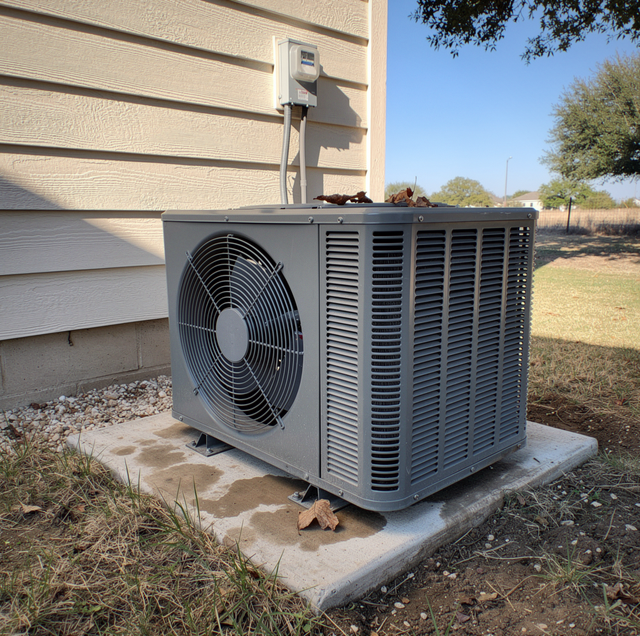
The thermostat is set low, the air from the vents feels closer to room temperature than cold, and out at the condenser beside the house, the wide blade on top is sitting perfectly still. Everything about that scene makes the fan look like the broken part.
That fan sits at the end of a chain. A call for cooling sends a 24-volt signal to the thermostat's control circuit, reaches the outdoor unit, and energizes the contactor coil. The contactor closes and hands line voltage to two motors at once: the compressor and the condenser fan. Any link in that sequence can break, and the motionless blade is only the part you can see. What comes with it, a hum or silence or an on-again fan, is what narrows the search.
Shut the System Down Before You Do Anything Else
Go to the thermostat and switch the system off before you study the unit any further. A warmer setpoint is not off, and neither is fan-only, which is safe only when the system is off.
The condenser coil dumps the heat your house gave up, and it can only do that while air is pulled across it. With the blade stopped, refrigerant leaving the compressor stays hot instead of condensing back into liquid; the discharge pressure climbs, and the compressor pumps against a wall it cannot get past. Heat builds in the windings and the oil lubricating the internal parts thins under it.
The compressor has no idea the fan has stopped. It runs on its own motor circuit and keeps pumping as long as the thermostat asks for cooling, so left alone the system walks back into that condition every time the house warms a degree. Shutting it off gives up cooling you were not receiving anyway.
A Hum With No Rotation Points at the Run Capacitor
Stand close enough to hear the unit, and a low, steady buzz off a blade that is not moving tells you more than any other symptom here. The hum means line voltage is reaching the motor and the windings are energized. What the motor cannot do is convert that into rotation.
To see why, look at what the run capacitor does. Household power is single-phase: it alternates back and forth along one line, and a single winding fed that way produces a magnetic field that pulses rather than sweeps. A pulsing field shakes a rotor without deciding which way to send it. The run capacitor feeds a second winding and advances its current by a fraction of a cycle, so that winding peaks first. Two pushes offset in time and in position add up to a field that travels around the stator, and the rotor follows it. That offset supplies the torque a single-phase motor needs to break away from rest, and the steady assist that keeps it turning.
It is the difference between two people shoving a merry-go-round at the same instant from the same spot, which mostly rattles it, and shoving it from two positions with one push always landing first, which sends it around.
Capacitors hold their charge in a material that degrades with heat and hours, and a condenser sitting in the sun through a long cooling season runs hot for months at a stretch. As the part drifts below the capacitance it was built to hold, the phase shift weakens and torque drops with it. The motor often spins fine once already moving, then one afternoon it cannot break away from a standstill. A fan that hums without turning is not a dead motor. It is a motor with power and no working way to start.
Many condensers feed both outdoor motors from one capacitor with separate sections, so one can lose its assist while the other carries on. That produces the pairing that does damage: a fan stalled at zero, a compressor still pumping heat into a coil nothing is cooling.
A run capacitor stores a lethal charge even with the power off and the disconnect pulled, and nothing from outside tells you whether it still holds one. Never open the service panel or touch a capacitor.
Total Silence Means Power Never Reached the Motor
Silence is a different report, sending the search back up the chain into the electrical and control side.
A tripped breaker: The outdoor unit has its own double-pole breaker in the main panel, which may have tripped due to an overload or a surge from a motor trying and failing to start.
A blown fuse in the outdoor disconnect: The small box on the wall beside the condenser usually holds cartridge fuses, a sacrificial link between panel and equipment. When one opens, everything downstream goes dark. That box is licensed work.
A contactor that will not pull in: This is the relay the low-voltage call operates. Its contacts pit and burn over years of switching; its coil can fail, and insects nest in it. When it does not close, both outdoor motors sit dead while the control side works perfectly.
A control-side interruption: Dead thermostat batteries, a small blade fuse protecting the 24-volt circuit at the air handler, or a float switch under the indoor drain pan that opens when the pan backs up, canceling the call for cooling. In that last case, the outdoor unit is doing precisely what it was told: nothing.
One observation separates most of these without touching anything: set the thermostat to cool and listen for the indoor blower. A blower running while the outdoor unit stays silent points at the outdoor power side or the contactor. Nothing in the responses points to the control side.
A Blade That Cannot Turn: Debris, Damage, and Seized Bearings
Sometimes the electrical side is entirely intact, and the shaft still will not move, which makes this the smallest slice of the problem and the easiest to picture.
Condenser fan motors ride on sealed bearings whose lubricant dries out under years of heat and running hours. As a bearing roughens, the shaft binds, and a motor asked to turn a shaft that will not move draws locked-rotor current until its internal protector or the breaker interrupts it. That failure rarely arrives unannounced: weeks of growling, a squeal on startup, or a wobble at speed usually come first.
Debris does the same job from outside. A branch dropped through the top grille, a bag pulled flat against the guard, or a blade bent by hail until it drags on the shroud will all hold a healthy motor at zero. A bent blade deserves attention even while it still spins, because the assembly is balanced, and an unbalanced blade grinds down the bearing behind it.
Motors also reach the end of their lives outright. Windings heat-cycled for years eventually short or open, and a burned-out motor accepts power and does nothing with it, which is why it can look identical to a spent capacitor from the driveway. Separating the two takes a meter.
Never start a stalled condenser fan by spinning the blade with a stick or your hand. The motor can energize without warning, and that space poses both a shock hazard and a risk of severe blade injury.
An Intermittent Fan Is a Protection Device Talking
Some of these calls begin with an apology, because by the time anyone looks at the unit, the fan is turning again, and the house is cooling. That pattern is the strongest clue here.
Two devices produce it. A high-pressure switch monitors the discharge side and opens when pressure exceeds its limit, which occurs when a coil is smothered or airflow stops. Because it drops the contactor, the whole unit stops and restarts, and many reset once pressure falls. The fan motor also carries a thermal overload, a bimetal contact that opens when the windings get too hot and closes again after they cool, which stops the fan alone while the compressor runs on. Either way the unit runs, quits, sits, and restarts with nobody touching it.
A fan that quits and comes back is not being temperamental. It is being protected. Each restart means the fault happened again and a safety device caught it again, and those devices are not meant to be a system's daily operating mode. What matters is the record: how long it ran, how long it stayed off, and how hot the day was.
Safe Checks From Outside, and the Line You Should Not Cross
Homeowners have a short and useful list here, and it stops before any panel comes off.
Turn the system off at the thermostat. Confirm it has live batteries and is actually calling for cool. Look at the breaker feeding the outdoor unit: if it has tripped, reset it once. That panel reset is the only sanctioned electrical action; nothing inside the unit qualifies. If it trips a second time, leave it off and call. A breaker that goes again is reporting a fault, and repeated resets only feed current back into it.
From outside the cabinet, look and listen. Note whether there is a hum, a click, or nothing, and whether you smell anything burning; a burning odor means the system stays off until a technician has seen it. Clear leaves and overgrown shrubs from around the unit, not from inside the guard.
What stays off the list is everything behind a panel. Do not open the electrical compartment, pull or inspect the disconnect fuses, look at, test, or replace a capacitor, press or jump a contactor, or free the blade by hand. Those terminals carry line voltage, the capacitor holds a charge with the power off, and there is no homeowner-safe version of either.
Describing the Symptom Well Shortens the Repair
Handing over a clear description before anyone opens a panel shortens the visit. Say whether the unit hums, clicks, or is silent, and whether the indoor blower runs when the outdoor unit does not. Say whether the breaker tripped and whether it held on a single reset. Say how long the system ran before the fan stopped, and whether it ever restarted on its own.
Say one more thing, because it changes the scope of the visit: how long it has been running this way. A fan that stopped an hour ago and one stalled through three hot afternoons while the compressor kept cycling are different service calls.
Frequently Asked Questions
Yes. The fan-only setting energizes the indoor blower on its own and sends no cooling call outside, so it moves air without putting the compressor at risk. One caveat: if the indoor coil is still wet, the blower re-evaporates that moisture and pushes it back into the house, so the air can feel more humid.
Nothing stops it until its own internal overload trips on temperature, and that overload is built for an isolated overheating event rather than a repeated pattern of them. Each trip costs winding insulation and oil, so a fan stalled through hot afternoons shortens the compressor's life.
Often, and one case is not a fault at all. Some newer condensers use electronically commutated motors that ramp their speed with demand and outdoor conditions, so a fan loafing at partial speed there can be normal. On a single-speed motor, a fan that turns but labors points to a weakened assist or a bearing beginning to bind.
It can contribute. An idle condenser fan will windmill in a gust, sometimes in reverse, and a motor asked to start into a blade already turning the wrong way has to stop it first. On healthy equipment that is a non-event; on a motor whose starting torque has already faded, it can be the difference between a start and a stall.
It does, because during heating the cycle reverses, and the outdoor coil becomes the one absorbing heat, which still requires airflow. There is one deliberate exception: during a defrost cycle, a heat pump shuts the outdoor fan off while it melts frost from the coil, so a still blade with vapor rising off the unit in cold weather is often correct operation.
The motor is normally replaced on its own, and the existing blade is often reused. Matching is what makes it a technician's part: a replacement must match the original in horsepower, voltage, speed, mounting, shaft diameter, and rotation direction. Rotation catches people out, since a motor built to turn the other way pushes air backward through the coil.
Outdoor fan sitting still while the unit hums — Get the condenser diagnosed while the repair is still just a fan motor. Above & Beyond Air Conditioning & Heating serves San Antonio and the surrounding Hill Country. TACLA00095687E. Call (210) 897-8658.