
Your vents are open, your thermostat is set to 74, and your house has been sitting at 79 since lunch. You walk out to the pad, hold a hand above the outdoor unit, and the air coming off it feels barely warm. Two coils do the cooling work in your system, and only one of them is likely the problem.
Those coils sit at opposite ends of one sealed loop. One is inside your house, pulling heat out of the air you breathe. The other is outside, radiating that heat into your yard. They share your refrigerant and your compressor, and they fail in ways that look nothing alike, so knowing which half you are describing changes what you tell a technician.
The Indoor Coil Absorbs Heat and the Outdoor Coil Sheds It
An air conditioner does not manufacture cold. In reality, the system works by absorbing heat inside and expelling it outside. Heat is collected in one room and put down somewhere else entirely, and each coil owns one end of that errand. The names describe what the refrigerant is doing, not what the air is doing.
The evaporator coil is the indoor half of the system, the cold heat exchanger that absorbs heat from the house air, turning warm return air into cool supply air. The condenser coil is the heat-rejecting half, the large aluminum-finned surface on the outdoor unit that releases heat from the refrigerant. One coil loads the refrigerant with heat. The other unloads it.
One Coil Sits in Your House, and One Sits Outside It
You can walk up to one of these coils and never once see the other. The condenser coil is the finned wall wrapped around the outdoor cabinet, in plain sight beside the house. The evaporator coil sits indoors in a sealed metal box above or beside the furnace or air handler, behind a screwed-down access panel, in the path of the air your blower pushes into the ducts.
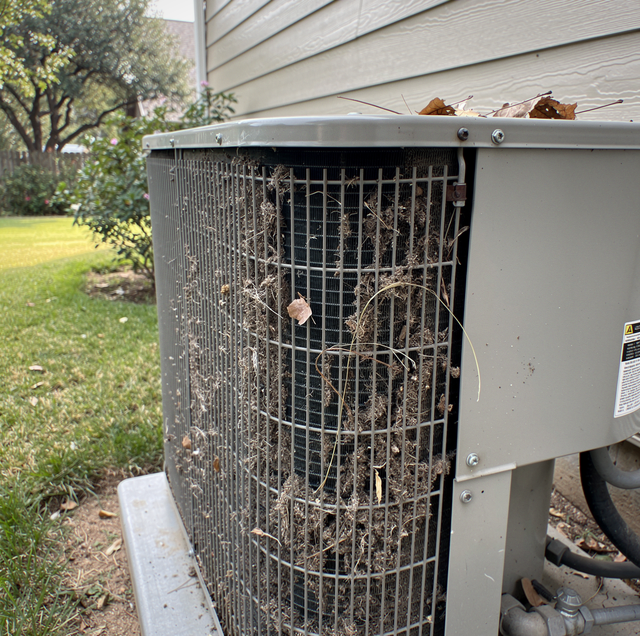
That asymmetry shapes what gets blamed. The coil you can see collects leaves and grass clippings where you notice them, so you sweep around it. The coil you cannot see collects a fine mat of dust on a permanently wet surface, and nothing on the outside of that cabinet shows you the mat is there. Both coils foul. Only one of them fouls in public.
The outdoor cabinet's electrical panel is opened by an HVAC technician who discharges the capacitor behind it first, because a stored charge there can injure or kill a person after the power has been switched off.
What Tells You Which Coil Is Struggling?
Both failures result in the same complaint: the house will not come down to setpoint. The difference shows up in what else happens while the system runs: how long a cycle lasts, how cold the air at the register feels, and whether ice or water turns up anywhere it should not.
Take the outdoor side first. When the finned surface out there is packed with dust and clippings, refrigerant arriving hot from the compressor cannot hand its heat off to the passing air. A fouled coil restricts heat rejection, raises refrigerant head pressure, increases compressor amperage, and accelerates compressor wear. What you feel at the register is air cooler than the room but never truly cold, from a system that runs and runs without satisfying the thermostat. Now take the indoor side. A starved evaporator coil gets colder than it was ever meant to get, because too little warm air crosses it to hold its surface above freezing. Moisture condensing there stops draining and starts building as frost, and frost narrows the air path further.
So one coil failing produces heat that will not leave, and the other produces cold that will not spread. Both look like weak cooling at the vent. What separates them is where the trouble shows itself: an outdoor unit running long and hot, or an indoor cabinet with frost on the copper and water under the pan.
Timing helps too. Fouling is slow, so a complaint that builds across two or three years points at a coil surface. A blockage or a leak develops within a day, and a system that was fine last week is pointing somewhere else.
Why a Fouled Condenser Coil Punishes the Compressor
The outdoor coil is the last chance your system has to get rid of the heat it collected indoors. Air pulled through the fins by the fan carries that heat away, and anything packing the fins blocks the handoff. Grass clippings thrown by a mower, cottonwood seed, pet hair, dryer lint, and ordinary road dust all pack into the same narrow gaps, and each layer leaves the fan working against a surface that has stopped breathing.
The compressor feels that as pressure. Refrigerant that will not condense stays high on the discharge side; the compressor draws more current to push against it, and heat builds inside a motor cooled by the very refrigerant it is moving. None of that trips anything on the day it begins. It shortens the compressor's life while your thermostat carries on asking for more.
Why a Fouled Evaporator Coil Turns Into Ice and Water
Indoors, the problem is not clippings but the coil's own working conditions. Evaporator coils are dirt magnets by their very design and function. A cold, wet surface in the return air path catches whatever your filter misses and holds it rather than letting it pass. That dirt effectively insulates the coil and blocks heat exchange, severely compromising the system's performance.
Fouling is only one way a coil can go wrong. When it freezes, leaks refrigerant, gets clogged with dust and biofilm, or corrodes through, an AC stops cooling effectively even when the compressor is running fine. Each of those ends at the drain pan under the coil, which has to carry off every drop the coil condenses, and a pan that overflows is how a coil fault becomes a ceiling stain.
Airflow Problems and Refrigerant Problems Look Alike From the Vent
A clogged filter and a low charge produce nearly the same story at the register, because both end with a coil that is too cold and an air path that is too tight. The filter is the piece you own. General maintenance guidance recommends inspecting, cleaning, or replacing air filters about once a month in a central air conditioner, furnace, or heat pump.
Past the filter, separating the two takes instruments. A technician measures temperatures across both coils and pressures on both sides of the compressor, and can distinguish a starved coil from a dirty one. That work happens on a sealed circuit, which is why it belongs to a licensed trade instead of a weekend. Your part is the filter, the clearance around the outdoor cabinet, and a clear account of what changed.
Replacing One Coil Drags the Other Into the Decision
Coils are not bought one at a time the way a fan motor is. The indoor coil and the outdoor unit are rated as a pair, and manufacturers publish performance for matched combinations, not for either half on its own. Put a new outdoor unit against an aging indoor coil, and the pair can behave unlike either rating.
The second reason is the work itself. Both coils live on the sealed refrigerant circuit, so replacing one means recovering the charge, cutting and joining copper, pulling a vacuum, and weighing a fresh charge back in. That is a licensed procedure with recovery equipment attached, and a contractor scopes it before anything is opened.
The Handoff: Describing Symptoms Before Anyone Opens a Panel
Your side of this is observation, and it is worth more than a guess at a part. Note whether the outdoor unit runs without stopping, whether the air at the register is cool or merely not warm, whether frost or water has turned up indoors, and when the change began. A technician takes it from there, with gauges on the sealed side and a meter on the electrical side.
Frequently Asked Questions
Yes, and the path is mechanical. That coil stays above freezing as long as enough warm room air crosses it. Starve that airflow, and the surface drops below freezing, so the moisture your house gives up stops draining and piles up as ice. You will feel weak airflow from your vents before you see frost.
It does, and not just for access. Your fan draws air in through the fins on the sides and discharges it upward, so a fence panel, a stack of your stored items, or a shrub grown against one face lets hot discharge air curl back into the coil it left behind. Feeding your coil its own exhaust raises the temperature you ask it to reject heat into.
Once a year is sufficient for the outdoor coil, since it is visible the moment the guard comes off. Your indoor coil usually gets skipped because seeing it means pulling an access panel on your air handler, plus a mirror and a work light. Ask for it by name when you book your visit, and ask about its condition.
On a young system carrying the same refrigerant at both ends, yes. On an older one, the refrigerant your indoor coil was designed around may not be what current outdoor units are designed for, and that mismatch forces the pair, whether you planned it or not. Age matters on its own terms too: a new coil bolted to your worn compressor inherits whatever life your compressor has left.
Sound alone will not locate it for you. Both of your coils sit on one refrigerant circuit, and your indoor cabinet is the quieter place to stand, so a noise you notice there did not start there. A hiss, a gurgle, or a bubbling note can each come from refrigerant crossing a restriction or escaping a small opening, and telling those apart is a leak search with electronic detection or dye. Record when in the cycle your sound starts and whether it fades.
Because the two jobs sit on different sides of your machine. Your filter lives in the return air path, outside every pressurized and electrical part of the system, and it slides out. A coil does not. Some components in an AC unit are highly pressurized, and others must be calibrated to tight tolerances to function properly. Your indoor coil sits in a sealed plenum behind a fastened panel with the refrigerant circuit running straight through it, and your outdoor coil is wrapped around a cabinet holding line voltage. Neither opens for you without opening something that should stay shut.
Not sure which coil is the problem — Have the indoor coil and the outdoor coil checked on one visit, before the system is asked to work any harder. Above & Beyond Air Conditioning & Heating serves San Antonio and the surrounding Hill Country. TACLA00095687E. Call (210) 897-8658.
