
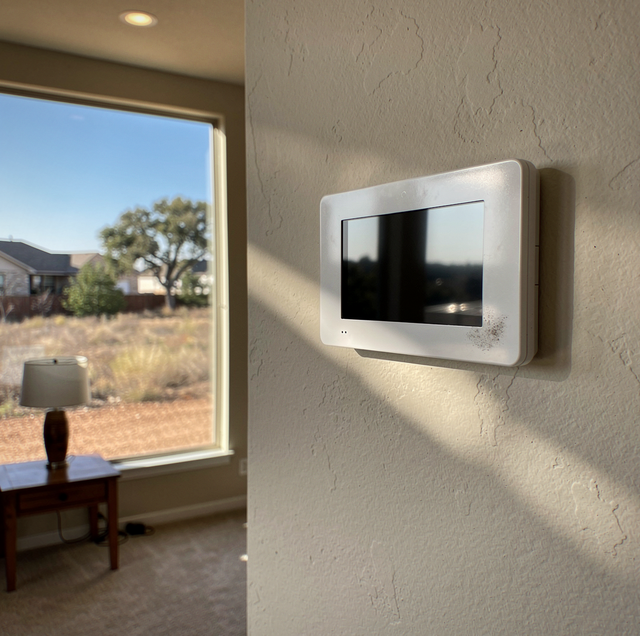
A thermostat does not measure the whole house. It measures the air immediately around its own sensor, inside a small housing mounted on one wall in one room, and every other room is inferred from that single point. A reading that is wrong can mean one of two different things: the sensor has degraded and is reporting the air around it incorrectly, or the sensor is working correctly and is measuring exactly what surrounds it, which is not the same as what the rest of the house feels like. Telling those two apart decides whether the fix is placement, a part, or nothing at all.
Each row pairs a pattern in the reading with the mechanism behind it, from a placement issue to a sensor that no longer works:
| Pattern | Likely Mechanism |
|---|---|
| Reads warm only on sunny afternoons | Direct sun reaching the sensor through a nearby window for part of the day |
| Jumps when a nearby supply register blows | Conditioned air landing on the sensor skews the reading in the moment |
| Reads cold on an outside wall or near a door | A draft reaching the sensor through the wall cavity or a settled door seal |
| Off by the same amount all day | A calibration drift in the sensor, or a heat source behind the wall that never switches off |
| Blank or flickering display | A power problem at the unit, not a temperature reading at all |
| A separate thermometer beside it agrees, but rooms still feel uneven | The reading is accurate; the mismatch lies elsewhere: airflow, duct losses, or sun load on those rooms |
Placement and Heat Sources Near the Sensor
A thermostat's sensor is a small component located behind the wall plate, and anything that changes the air temperature in that small space affects the reading, regardless of how the rest of the room feels. Direct sun through a nearby window can warm the plate and the air around it for part of the day, and that shows up as a reading that climbs in the afternoon and settles back once the sun moves off the wall. The mechanism is the same on any wall with a window catching afternoon light, not a feature of one direction, one room, or one house. A lamp, a television, or another piece of electronics placed close to the unit adds the same kind of localized heat. A supply register aimed straight at the sensor does the opposite: conditioned air lands on the plate and skews the reading toward whatever air happens to be blowing at that moment, rather than the room as a whole. Proximity to a kitchen puts its heat source within range whenever cooking is underway. A draft reaching the sensor through the wall cavity itself, behind an exterior wall or near a door where the seal has settled, pulls the reading the other way, toward cold. None of this is a fault of the unit; it is a mismatch between what the sensor sits in and what the surrounding room is doing. Correcting it can mean relocating the thermostat to a wall away from all of these influences, which is wiring work behind the plate for a technician.
Dust, a Failing Sensor, and an Out-of-Level Unit on Older Models
Even with placement ruled out, the sensor itself can be the source of a wrong reading. Dust settling on and around the internal sensing element changes how it responds to the air moving past it. Electronic components inside a digital thermostat can also drift with age, producing a reading that holds a steady offset rather than one that swings with the time of day. On an older mechanical thermostat whose bimetal coil tips a small switch capsule, a unit mounted slightly out of level shifts the temperature at which the system turns on and off. A unit that is level, clean, and free of heat sources and drafts, yet still reads consistently wrong, has either drifted out of calibration or has a failing sensor.
Batteries Drained Partway
On a battery-powered unit, a partially drained battery can make the display flicker or the reading jump before the unit goes blank outright, so a fresh set is worth ruling out before anything else is checked.
Checking the Reading Against a Separate Thermometer
There is one check worth running before calling for service. Set a separate thermometer next to the thermostat, keep it away from the same influences that skew the thermostat itself, meaning sun, a supply vent, or a draft, and let both settle before comparing the numbers.
A thermometer carried in from another room, held in a hand or laid flat on a shelf, reads its own surroundings until its number stops moving, so a reading taken the moment it is set down reflects the room it came from.
If the two agree, the thermostat is reading the air around it correctly, and any mismatch with how the rest of the house feels comes from somewhere else in the system. If they disagree, the gap itself is useful: a swing that tracks the time of day or the system running comes from placement, while a wrong reading that holds steady comes from the sensor or from a heat source that never switches off. This check stops at reading a thermometer. Opening the wall plate or handling the wiring behind it is not a homeowner step, whether the system is powered or not.
Carbon monoxide or a gas smell during a furnace call for heat outranks any suspect thermostat reading; the household belongs outside, the call is made from there, and the responding technician clears the house before anyone checks the thermostat.
When the Reading Is Right, and the House Is the Problem
An accurate thermostat does not guarantee an even house. A room that stays warm no matter what the thermostat reads is a sign that airflow, sun load, or duct condition in that room needs a look, not a sign the thermostat is wrong. A system that short-cycles, restarting in rapid bursts rather than running a full cycle, can be triggered by a poorly placed thermostat, though a correctly placed one does not rule out the other causes behind that pattern. A system that runs without lowering the temperature at all, even next to an accurate thermostat, has a problem on the equipment or airflow side, from the filter and coil to refrigerant or duct losses. And ducts that lose conditioned air before it reaches a room can leave the house feeling uneven even when the thermostat's own reading checks out against a separate thermometer.
Recalibrate, Relocate or Replace: How the Service Visit Decides
A thermostat service visit starts by comparing the unit's reading against a calibrated reference, the same side-by-side check, but done with equipment that removes the doubt about a household thermometer. From there, the wiring connections at the plate and the equipment are checked, since a loose connection can cause the display to reset or the system to respond erratically. Placement gets weighed against sun, nearby heat sources, direct supply air, and drafts through the wall cavity. What happens next depends on what is found. A unit that is misreading because of where it sits is relocated to a wall that better represents the living space. A unit that corrects with a small adjustment gets corrected in place. A sensor that has failed outright, meaning no adjustment or relocation changes the outcome, gets replaced rather than repaired, since the sensing element itself is not something a technician services in place once it has gone bad.
Frequently Asked Questions
A thermostat mounted on a wall shared with a water heater closet, a fireplace chase, or the back of a refrigerator picks up that heat through the wall itself, so the plate reads warm even when nothing in the room is running.
On some models, a small calibration offset lets a technician correct a consistent, minor bias without replacing anything. A sensor that has drifted beyond the offset it can correct, or has stopped working altogether, gets replaced rather than adjusted, since the correction only works within a limited range.
No. A gap that appears right after a space heater, an aquarium, or a new appliance is placed near the unit tracks that change, and moving the item back and comparing again separates a new heat source from a sensor fault.
Some smart models can average in remote room sensors, so the number on the wall can be a blend of rooms instead of the air at the plate, which changes what "wrong" means.
A curtain, a tall piece of furniture, or anything else that blocks normal air movement around the unit traps a small pocket of air at a temperature different from the room's. The sensor then reports the trapped pocket's temperature as if it were the whole room's temperature.
A blank display with the system still audibly running can mean the low-voltage circuit lost the thermostat's own power without cutting power to the equipment, which is checked before the thermostat itself is condemned. That is a different repair than a sensor problem.
Hire a thermostat service — a reference-thermometer check that determines whether this unit needs recalibration, relocation, or replacement. Above & Beyond Air Conditioning & Heating serves San Antonio and the surrounding Hill Country. TACLA00095687E. Call (210) 897-8658.