
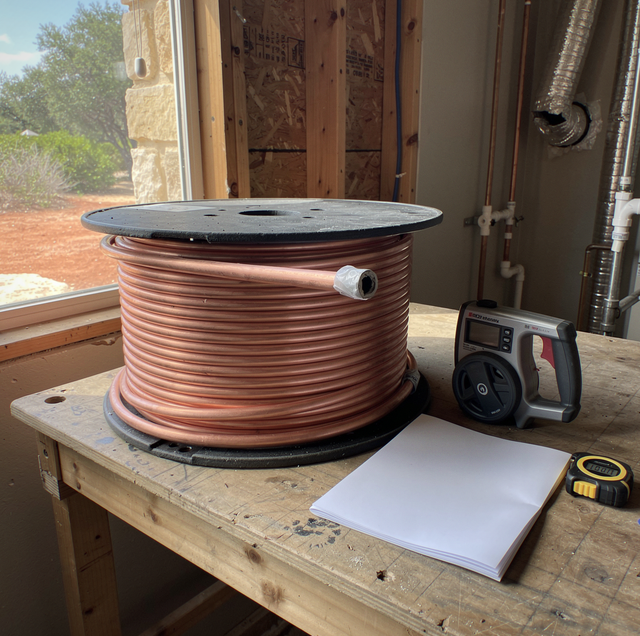
A mini-split's line set is the insulated pair of refrigerant lines running between the indoor head and the outdoor unit, bundled with a low-voltage control wire and, where the head drains out through the same wall opening, a condensate drain line for the moisture the indoor unit collects. It looks like ordinary copper tubing and field wiring, and on a simple wall-to-wall run, it works that way. Its length still has a ceiling. Every model a manufacturer sells is engineered and tested against a maximum line length and a maximum vertical rise between the two halves, and capacity falls off before either limit is reached. Before the outdoor unit goes on its pad, an installer works out what the planned run will cost the system once it's in place.
Each factor on a long run changes what the system delivers once it's running, and they act together:
| Factor | What It Changes |
|---|---|
| Total line length | Pressure drop along the run, which reduces refrigerant flow and cooling or heating capacity at the head |
| Vertical rise, outdoor unit below the indoor head | How much lift the refrigerant and the oil it carries have to climb against gravity |
| Vertical rise, outdoor unit above the indoor head | A different lift problem, working the opposite direction through the line |
| Length past the factory pre-charge | The added refrigerant weight a longer run needs beyond what the unit ships with |
| Bends, kinks and flattened tubing | Restriction that adds resistance without adding a single foot of measured length |
| Gaps or damage in the line insulation | Heat gain or loss along the run, plus sweating and dripping condensation |
Why Distance Costs Capacity
Refrigerant moves through the line set under pressure, changing from liquid to gas and back as it carries heat between the indoor head and the outdoor unit. Every foot of copper the refrigerant travels through adds a small amount of resistance, called pressure drop. A longer line means more resistance, which means the compressor works harder to push the same volume of refrigerant through the loop. As length increases, the compressor can't fully close the gap, and the head delivers less capacity than its rated output, even though nothing in the system has failed. The maximum length figure marks where the design margin runs out; inside it, capacity still slips as length is added, which is why a shorter route is worth finding even when a longer one is allowed. A run pushed past the maximum operates outside the conditions the compressor and controls were tested against.
Vertical Lift and Oil Return
The compressor in the outdoor unit relies on a small amount of oil that travels with the refrigerant through the entire loop, lubricating moving parts as it circulates. On a level run, gravity does not work against the oil's return to the compressor. On a run with real vertical rise, the refrigerant has to carry that oil upward against gravity, and the line has to be sized and routed so that oil keeps moving rather than settling at the low point of a bend or a trap. An outdoor unit set below the indoor head faces one version of that lift problem; an outdoor unit mounted above the head, on a balcony bracket or a roof curb, faces the same problem working the opposite direction. Either way, a vertical rise beyond the model's rating risks oil pooling somewhere along the line rather than returning to the compressor with each cycle. A compressor running short on oil wears against parts that were never meant to run dry, and the damage can accumulate, shortening its service life before any shutdown shows it.
The lift figure for a model can differ depending on whether the outdoor unit sits above or below the indoor head, so the measured height difference is matched to the right direction before a location is chosen.
The Pre-Charge and the Added Charge a Longer Run Needs
Every mini-split ships from the factory pre-charged with enough refrigerant for a baseline line length set for that model. Once the installed run is longer than that baseline, the extra length needs extra refrigerant weighed in to match it, a fixed amount added per foot beyond the pre-charge point, set for each model rather than estimated on the job. This step occurs during commissioning, after the line set is installed and pressure-tested, and after air and moisture are drawn out of it, before the system is handed over for operation. Skipping that step, or eyeballing the added charge instead of weighing it in, can show up later as reduced capacity, a compressor working outside its designed operating range, or a system that never quite reaches the setpoint on the hardest days of the year, the same symptoms a plain pressure drop produces. That overlap is exactly why the charge gets verified rather than assumed. Power to the outdoor unit is shut off at its disconnect before anyone opens or touches it, and charging, cutting, or re-flaring the lines, or opening the service valves on a pre-charged unit, is left to a certified technician. DIY quick-connect kits are a separate product, with line sets that come pre-charged in fixed lengths and join at threaded couplers.
Routing, Bends, Insulation and the Wall Penetration
Between the indoor head and the outdoor pad, a line set can bend around framing, drop through a wall cavity, and make at least one turn to reach the exterior penetration. Each bend adds resistance the same way extra length does, which is why a tightly coiled excess loop left behind an indoor head, coiled to take up slack rather than cut to length, adds resistance without changing the measured footage of the run. A kink or a flattened section is worse: instead of a smooth bend, it creates a narrow point that restricts flow at a single spot in the line. Insulation has its own job, separate from all of this. A continuously insulated line keeps the refrigerant temperature stable along the run and keeps the outside of the tubing from sweating in humid air; a gap in that insulation, at a coupling or where the line rubs against framing, lets moisture condense on the bare copper and drip, which can be mistaken for a leak even when the refrigerant charge is intact. The wall penetration itself is sealed once the line set, drain, and control wire pass through it, closing the opening that would otherwise allow outside air and moisture to track into the wall cavity.
A line set holds refrigerant under pressure even with the system off. Opening a fitting, cutting the tubing, or breaking a valve seal releases it fast enough to freeze skin and eyes, and only a certified technician opens the system.
How Unit Placement Gets Decided
The indoor head goes where the room needs conditioned air delivered, and a garage bay, an added bedroom, or a converted bonus room can leave only one workable wall or ceiling location for it. The outdoor unit has more flexibility. It can sit on a pad near the foundation, be mounted on an exterior wall bracket, or, in a multi-story layout, sit on a roof curb or a balcony bracket. Placement gets decided by working backward from the model's rated length and lift limits against the shortest workable route between those two fixed points, accounting for the bends and rise that route will require, not a straight-line distance measured on paper. When the calculated run approaches a model's maximum, or the vertical lift alone brings the route near the model's lift limit, the fix is one of two changes. Either the outdoor unit moves to a closer or lower position where the layout allows it, or the installation calls for equipment sized and pre-charged for the longer end of that range, rather than a shorter-range model pushed past its rated limit. A shorter run within the model's limits yields less capacity than a run at the edge of those limits, and a run past the limits starts the system's service life working against itself.
Frequently Asked Questions
On some models, yes. A run shorter than the model's minimum can leave the factory charge too large for the circuit and allow outdoor-unit vibration to carry through the tubing, which is why a short route may include an additional flat loop of tubing to reach that minimum.
No. The added refrigerant a longer run needs replaces only the extra weight that the specific length calls for; it does not restore capacity lost to pressure drop once a run is past the model's rated maximum. Overcharging beyond the calculated weight creates a separate problem: refrigerant that should remain vapor on its way back to the compressor returns partly as liquid, which the compressor is not built to handle.
On some models, yes. Certain mini-split lines are offered with more than one line-set diameter for the same indoor and outdoor pairing, and the larger diameter carries less pressure drop over an equal length. Where that option exists, a run near the top of the rated maximum can call for the larger diameter rather than relying on refrigerant weight alone to close the gap.
On a multi-zone system, the route can pass through a branch box partway along the path, which splits the piping into a main run to the box and shorter runs from the box to each head, each with its own limit. The unit selection changes to match the route, rather than forcing the route to fit the unit already picked.
Yes. Each bend is counted as an added equivalent length on top of the measured distance, and a short run with several tight turns can add up to more equivalent length than a longer run laid out straight.
No. Insulation controls heat gain, heat loss, and condensation on the tubing; it does not affect the pressure drop created by a line's length, bends, or elevation change. A heavily insulated run at or past a model's maximum length loses the same capacity as the same run with standard insulation.
Contract ductless mini-split installation — line set sizing, routing, and a weighed-in charge for the run's length. Above & Beyond Air Conditioning & Heating serves San Antonio and the surrounding Hill Country. TACLA00095687E. Call (210) 897-8658.