
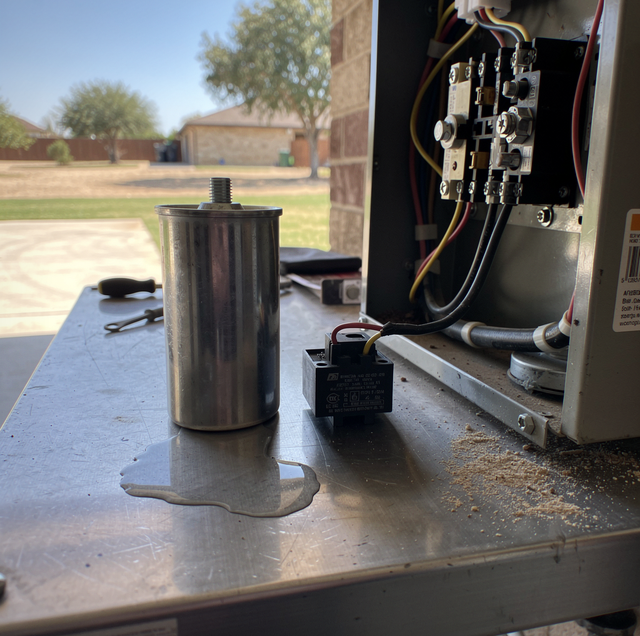
A hard-start kit and a capacitor replacement are pulled out for the same complaint: a compressor that hums, hesitates, or won't start on the first try. They are not the same repair, and swapping one in for the other can leave the actual problem untouched. Replacing a capacitor corrects a part that has drifted out of spec. A hard-start kit installs a part that wasn't there to begin with, giving an aging compressor extra torque it didn't have when it was new. Telling which one a struggling compressor actually needs starts with what each part does, and does not do.
The Run Capacitor's Job, and Why It Wears Out
Every start needs a jolt of torque to break the compressor's rotor away from a dead stop, and household power alone can't supply that cleanly. The run capacitor shifts the timing of the current in a second winding, so the motor's field rotates instead of just alternating, which gets the rotor turning and keeps it turning smoothly. The capacitor has no moving parts of its own, but it drifts below its rated capacity as it ages, and once it does, it can no longer deliver the push the motor was engineered around. That drift follows hours of operation more than the calendar, so a capacitor on a system that runs most of the year reaches it sooner than the same part on one with a short season. A capacitor replacement restores that part to its original spec, and the compressor starts the way it did when the system was new.
The Extra Torque a Hard-Start Kit Supplies
A hard-start kit isn't a stronger run capacitor; it pairs a separate start capacitor with a relay, wiring both into the start winding to deliver one extra burst of torque the instant the compressor tries to move, then it drops back out of the circuit within about a second once the motor nears running speed. Where the run capacitor's assist lasts for as long as the motor turns, the kit's contribution is a single push at zero. That distinction matters, because a kit doesn't correct anything about the run capacitor's ongoing performance. It compensates for a compressor that needs more starting torque than its winding alone can provide, whether due to wear or to restarting against pressures that haven't evened out.
Why a Compressor Loses Starting Torque in the First Place
Hesitation usually comes down to one of a handful of causes: a run capacitor that has weakened, internal wear that raises the torque the compressor needs, a restart against pressures that haven't equalized since the last cycle, or low voltage at the unit. Only the first is fixed by a new capacitor. A run capacitor that has fallen below the microfarad rating printed on its case no longer provides the motor with the field it needs, and replacing it restores things exactly as they were. Mechanical wear is different: as scroll or piston parts and bearings wear, internal friction rises, and the compressor simply needs more torque to get moving than its start winding was ever designed to supply, even with a healthy capacitor in the circuit.
A capacitor retains a dangerous electrical charge long after the unit is shut off, and both it and a hard-start kit are located inside a live electrical compartment. Turn the system off and let a licensed technician handle the repair.
Compressor Age and Wear History Point the Decision
Age and repair history carry more weight in this decision than the hesitation itself does. A compressor that hesitates to start for the first time, on a system still well within its expected service life, usually indicates a capacitor that has reached the end of its working life. The electrical component failed on its own schedule, while the compressor beneath it is still sound. A compressor on an older system, especially one that has already had a capacitor replaced once and is starting to hesitate again, is telling a different story: the mechanical wear inside it has advanced to the point where even a fresh, correctly rated capacitor isn't enough on its own. That's the compressor a hard-start kit is built for, and it's also the compressor closest to needing a full swap rather than either fix.
Read "age" in hours of operation and number of starts, not only the date on the nameplate. A unit that carries the house for most months of the year collects both far faster than one that works hard only through a brief summer, so it reaches the wear that calls for a kit sooner; the brief-summer unit at the same age is more likely still a plain capacitor case. A system that short-cycles from an oversizing problem adds to that same total, layering extra starts on top of whatever its season length alone would produce.
When Both Parts Are Replaced at the Same Visit
A technician sometimes replaces the run capacitor and adds a hard-start kit in the same visit rather than choosing one or the other. That combination comes up when a capacitor tests out of spec and the compressor is old enough, or has enough hours on it, that a fresh capacitor alone is judged unlikely to hold up reliably through the rest of the season. Replacing the weak part and adding the extra assist at once can mean one visit instead of a callback if the capacitor alone doesn't get the job done. It is a judgment call based on the compressor's age, its history, and how it behaves once the new capacitor is in, not a default upgrade for every capacitor swap.
Weighing the Two Fixes Side by Side
| Decision Factor | Points Toward Capacitor Replacement | Points Toward a Hard-Start Kit |
|---|---|---|
| First-time hesitation on a system still well inside its expected service life | Capacitor likely tests out of spec on its own, unrelated to compressor wear | Rarely needed yet |
| Hesitation returns after a capacitor was already replaced once, on an older compressor | Still replaced if it tests out of spec, but rarely the whole answer | Mechanical wear likely needs the added torque, often paired with a fresh capacitor |
| Capacitor tests within its rated range but hesitation continues | Not the fix, since the part in question tests fine | Addresses torque the winding itself can't supply |
| Long vs short cooling season at the same compressor age | More often the whole fix on a short-season system at the same age | A long season's worth of extra hours and starts can bring a marginal compressor to this point sooner |
The Limits of Both Fixes
A hard-start kit and a capacitor replacement both address getting the compressor moving. Neither one touches refrigerant charge, a restricted metering device, or airflow problems at the coil, all of which can also make a system seem like it's straining even when the compressor itself starts just fine. If a compressor hesitates to start and, once running, still isn't cooling as it should, the starting problem and the cooling problem may not share a common cause. Fixing the start doesn't guarantee the second issue clears up on its own, so a technician checks the system's actual performance after either fix, not just whether it turns over.
Frequently Asked Questions
Usually not as a blanket precaution. A hard-start kit's start capacitor and relay are matched to the compressor's own starting characteristics. Hence, a technician selects one against the compressor's nameplate data rather than treating it as a universal add-on. Installing a kit before a compressor shows any starting trouble also removes the early warning sign a technician would otherwise use to catch a developing capacitor or winding problem.
No. A soft-start device limits the inrush current surge at startup, while a hard-start kit adds torque; one eases what the electrical supply must deliver, the other gives a struggling motor more force.
A relay does that job, either an electromechanical potential relay or a solid-state PTCR, a positive temperature coefficient resistor, and the two work on different principles. A potential relay opens when the voltage across the start winding rises as the motor comes up to speed. A PTCR instead heats with current, and its resistance climbs until it effectively removes the start capacitor on a timing basis, not by sensing how fast the motor is turning.
Yes. Thermostats have a cycle-rate setting, often labeled cycles per hour, and one configured for more cycles per hour than the equipment calls for starts the compressor more often at the same comfort level than a correctly set one. Over the years, the unit behind the higher setting reaches the hesitating stage sooner.
No. If a compressor needed a kit just to get moving and then draws high running current or trips its overload once it's running, the kit only solved the starting moment, not whatever wore the compressor down in the first place.
Yes, on some equipment. Manufacturers often call for one on systems with a non-bleed expansion valve, which holds pressure across the valve during the off-cycle, so the compressor restarts against high and low sides that never equalized. It is tied to that valve, not a universal upgrade.
If your compressor has started hesitating, ask for the capacitor to be measured and the compressor's starting draw checked on the same visit — that reading decides between a new capacitor, a kit, or both. Above & Beyond Air Conditioning & Heating serves San Antonio and the surrounding Hill Country. TACLA00095687E. Call (210) 897-8658.