
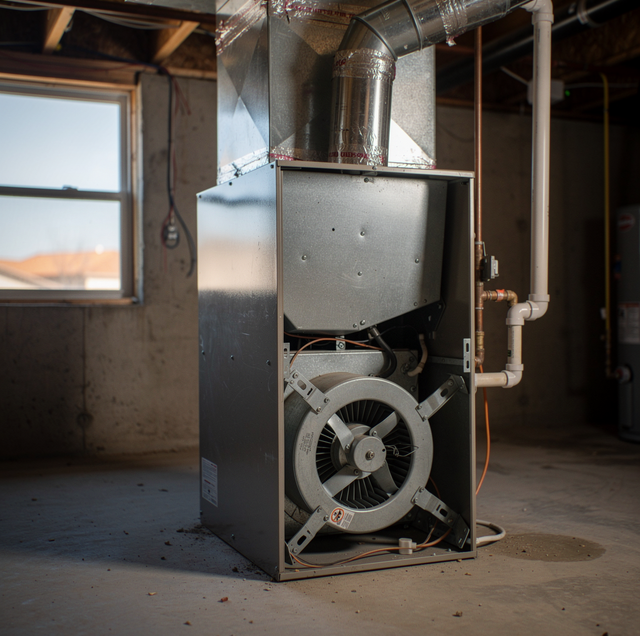
Inside the air handler or furnace cabinet, a blower motor turns a squirrel-cage wheel that pulls room air across the coil or heat exchanger and returns it to the rooms through the supply ducts. In cooling mode, that moving air is what lets the coil pull heat out of the house at all. In heating mode, it is what carries warmed air out of the cabinet before the heat exchanger runs hotter than it should. When the motor weakens, slows, or seizes, everything downstream of it degrades with it. The table pairs each blower complaint with whether it points to the motor itself or to something feeding it bad air.
| Sign | Blower or Something Else |
|---|---|
| Weak airflow at every vent | Can point to the blower once a new filter and open registers haven't fixed it; a dirty coil does the same |
| Humming with no airflow | The motor is powered but can't turn: a failed capacitor, a seized bearing, or a wheel dragging in its housing |
| Squealing or grinding | Mechanical: worn bearings or a wheel that has gone loose or unbalanced in its housing |
| Burning or hot electrical smell at the air handler | Electrical: overheating windings — shut the system off |
| Blower runs nonstop | Check the fan setting before assuming a failing motor; a stuck relay can also hold it on |
| Starts slow or cycles off early | A weak capacitor, or the motor's thermal protector opening on hot windings |
PSC vs Variable-Speed (ECM) Blowers
Residential blowers use one of two motor designs, and the design changes what a failing motor looks and sounds like. A PSC motor (permanent split capacitor) is an alternating-current motor designed to run at one of a handful of fixed speeds, set by wiring taps on the control board. It needs a capacitor to get moving and keep running smoothly, so a PSC blower's failure signs are blunt: it hums and stays still, runs weak, or stops.
A variable-speed motor, known as an ECM (electronically commutated motor), works on a different principle. It's a DC motor with its own built-in electronics. In a variable-speed model, the electronics adjust speed to maintain the airflow the system calls for; a constant-torque version runs at set torque taps instead. Because that control board manages current and can detect a fault, an ECM blower can respond to a developing problem by limiting its speed to a reduced or erratic setting rather than stalling outright. A blower that ramps up oddly, hunts between speeds, or won't reach full speed can point to the motor's control module, the control board's signal, or a restriction the motor is fighting.
The Capacitor, the Bearings, and the Wheel
The capacitor, the bearings, and the wheel can each fail independently and produce overlapping symptoms. A weakened capacitor can produce the same hum-without-turning symptom as a seized motor, since it fails to deliver the jolt a PSC motor needs to start, which is why a technician checks the capacitor before condemning the motor itself.
The motor's bearings support the shaft the wheel spins on, and years of running hours dry out their lubrication and roughen the metal underneath. A bearing starting to fail can squeal at startup or grind steadily while running; a bearing that has already seized stops the shaft cold, and a motor straining against a locked shaft draws current beyond its rated amperage. That overdraw can trip a breaker or open the motor's own thermal protector on a blower that otherwise looks fine from the outside.
The wheel itself, the curved squirrel-cage fan that moves the air, has its own failure points separate from the motor driving it. A set screw that has backed out lets the wheel slip on the shaft, spinning at less than the motor's intended speed or catching and releasing in a way that reads as an intermittent motor problem. A wheel loaded with dust and grime effectively narrows the gaps between its blades, moving less air for the same motor speed, which can make a perfectly healthy motor look like it's underperforming until the wheel itself is cleaned.
A blower motor with burning windings can arc or ignite nearby insulation and dust inside the air handler. Turn off the thermostat and the breaker, and leave the cabinet closed until a technician inspects the motor and wiring.
Clogged Filters and Dirty Wheels That Make a Good Motor Look Bad
Before any part inside the blower assembly gets blamed, it's worth ruling out what's feeding it. A filter packed with dust chokes the volume of air the motor has to pull through, and the blower moves less air even while the motor itself is sound. Closed supply registers, a return grille blocked by furniture, and a coil coated in grime all do the same thing from different points in the system: they cut the air the blower can move, with the motor spinning at full speed.
Before a service call, note which mode the problem shows up in (heating, cooling or both) and when the filter was last changed. Those two facts tell a technician whether to start at the motor or at the airflow path.
A technician separates a restriction from a motor fault by reading the static pressure the blower works against and comparing the motor's draw with its nameplate, rather than judging by ear. High static pressure points at the filter, the coil, or the ducts; normal static pressure with weak airflow and an abnormal draw points at the motor, its capacitor, or the wheel.
What a Failing Blower Does to the Coil and the System
A blower that can't move its designed volume of air puts stress on whatever sits on either side of it. On the cooling side, too little warm air passing over the evaporator coil causes its surface to drop below freezing, and moisture that would normally drip off instead turns to frost. On the heating side, air that lingers too long in the cabinet keeps the heat exchanger running hotter than it was built to run, and a furnace moving too little air across it will not keep running that way indefinitely.
The compressor feels the strain too, working to move refrigerant through a coil that isn't getting the airflow it needs to do its job, and a system fighting a weak blower runs longer to deliver the same comfort, which shows up as a climbing energy bill even before the motor fails outright. That damage can accumulate while the blower is still running, so a weak or struggling motor is worth diagnosing while it is still turning.
Repairing or Replacing the Blower Motor
Once a technician has confirmed that the motor itself is the problem, the choice between repair and full replacement depends on several practical factors, with no single rule that fits every job. A PSC motor has universal replacements with an adjustable mounting band and several speed taps, so the part is simple to source and swap years after the original went in. On some systems, an ECM motor is programmed for that equipment, so a swap requires a matched part, and a technician confirms the match before ordering.
Age and history factor in, but a motor's age in years can mislead. Through a long cooling season with the system running nearly nonstop, the blower piles up running hours on its bearings; where cooling is needed for only a short season, the same motor logs few of those hours in a year and its bearing wear stays slight. Two blowers installed in the same year can show different levels of wear, so a technician considers the motor's condition and operating history alongside its installation date. A motor failing early on a system that's otherwise sound is a case for a standalone repair. A motor failing on a system already old enough that other components are due, or one that's already had a motor replaced once, is a different conversation, one a technician has with the full system's condition in view rather than the blower alone. Either way, the diagnosis identifying the motor as the cause is the same one that tells a technician which path applies.
Frequently Asked Questions
Only if it has oil ports. Some older motors have small capped ports in the housing that take a few drops of lightweight, non-detergent oil during service visits. A permanently lubricated, sealed motor has no ports at all, and oil added to its housing does nothing for the bearings inside.
Yes, on the heating side. A furnace has a switch built to shut the burner off if the blower can't move enough air across the heat exchanger to keep the heat exchanger within its designed operating temperature. A blower moving too little air can trigger that shutoff during a heating cycle even though the burner itself is working fine, which can make a weak blower look like a burner problem.
Yes. Multi-speed PSC motors connect to the control board through several color-coded leads, one for each available speed. If a lead is moved to the wrong tap during a repair or a control board swap, the blower runs at an unintended speed. A blower that seems weak but tests fine on the bench is worth checking the wiring before condemning the motor itself.
No. Some furnace blowers are belt-driven rather than directly coupled to the motor shaft, and a squeal on one of those can be a belt that has glazed or started slipping rather than a bearing going bad. A technician checks belt tension and condition on a belt-driven unit before opening up the motor itself.
Yes. A UV germicidal light or an electronic air cleaner mounted in the duct depends on the blower pushing air past it to do its job, so a motor moving less air than it should cuts into how much of the airstream those devices treat, even though the device itself still has power and appears to be working normally.
Not safely on its own. A blower motor is matched to the duct system's static pressure and the coil or heat exchanger's design airflow, and installing a stronger motor than the system calls for can overdrive the wheel, push the coil past the airflow it was engineered for, and strain the ductwork rather than fix an underlying restriction. A technician who finds airflow low first looks for what's restricting it before considering a different motor at all.
Arrange a blower motor diagnosis with an AC repair visit — a technician tests the motor, capacitor, and wheel, measures airflow, and repairs or replaces what has failed. Above & Beyond Air Conditioning & Heating serves San Antonio and the surrounding Hill Country. TACLA00095687E. Call (210) 897-8658.